The smartphone growth is global

Last October, we launched Our Mobile Planet, a resource enabling anyone to visualize the ways smartphones are transforming how people connect with information, each other and the places around them.

Today, we’re releasing new 2012 research data, and the findings are clear—smartphone adoption has gone global. Today, Australia, U.K., Sweden, Norway, Saudi Arabia and UAE each have more than 50 percent of their population on smartphones. An additional seven countries—U.S., New Zealand, Denmark, Ireland, Netherlands, Spain and Switzerland—now have greater than 40 percent smartphone penetration. In the U.S., 80 percent of smartphone owners say they don’t leave home without their device—and one in three would even give up their TV before their mobile devices!
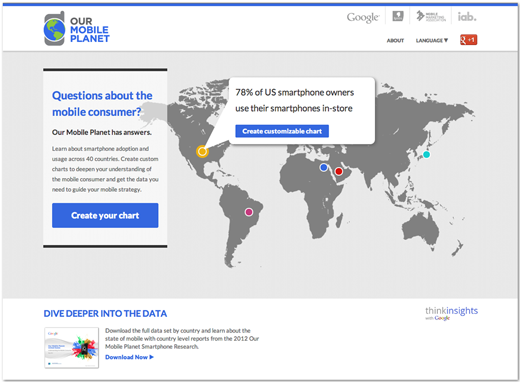
We conducted this research to help people to better understand how mobile is changing our world. You can learn about mobile-specific usage trends, use this tool to create custom visualizations of data and more. There’s plenty to discover in the latest research—to dig into new survey data about smartphone consumers in 26 countries from around the world, read our post on the Google Mobile Ads blog or visit http://thinkwithgoogle.com/mobileplanet.

A tribute to Bob Moog

In the mid-1960s, Dr. Robert Moog unleashed a new universe of sounds into musicdom with his invention of the electronic analog Moog Synthesizer. The timbre and tones of these keyboard instruments (true works of art in and of themselves) would come to define a generation of music, featuring heavily in songs by The Beatles, The Doors, Stevie Wonder, Kraftwerk and many others.

When people hear the word “synthesizer” they often think “synthetic”—fake, manufactured, unnatural. In contrast, Bob Moog’s synthesizers produce beautiful, organic and rich sounds that are, nearly 50 years later, regarded by many professional musicians as the epitome of an electronic instrument. “Synthesizer,” it turns out, refers to the synthesis embedded in Moog’s instruments: a network of electronic components working together to create a whole greater than the sum of the parts.

With his passion for high-tech toolmaking in the service of creativity, Bob Moog is something of a patron saint of the nerdy arts and a hero to many of us here. So for the next 24 hours on our homepage, you’ll find an interactive, playable logo inspired by the instruments with which Moog brought musical performance into the electronic age. You can use your mouse or computer keyboard to control the mini-synthesizer’s keys and knobs to make nearly limitless sounds. Keeping with the theme of 1960s music technology, we’ve patched the keyboard into a 4-track tape recorder so you can record, play back and share songs via short links or Google+.

Much like the musical machines Bob Moog created, this doodle was synthesized from a number of smaller components to form a unique instrument. When experienced with Google Chrome, sound is generated natively using the Web Audio API—a doodle first (for other browsers the Flash plugin is used). This doodle also takes advantage of JavaScript, Closure libraries, CSS3 and tools like Google Web Fonts, the Google+ API, the Google URL Shortener and App Engine.

Special thanks to engineers Reinaldo Aguiar and Rui Lopes and doodle team lead Ryan Germick for their work, as well as the Bob Moog Foundation and Moog Music for their blessing. Now give those knobs a spin and compose a tune that would make Dr. Moog smile!

LEO, the first business computer

Recently  it was the 60th anniversary of LEO, the world’s first business computer—built by J.Lyons & Co, a leading British food manufacturer at the time that also ran a famous chain of tea shops.

Lyons management had long been keen to streamline their back-office operations. In 1947, two Lyons managers visited the U.S. to learn about the latest business processes, including whether the electronic computers they’d heard about during their wartime service, like ENIAC, might be useful. (At the time, the closer-to-home advances at Bletchley Park were still a well-kept military secret.)

They returned inspired by the possibilities and keen to build a machine of their own. After several years of development, LEO, a.k.a. Lyons Electronic Office, took on its first office job on November 17, 1951—weekly valuations for the bakery division, calculating margins on Lyon’s output of bread, cakes and pies.

Until LEO, computing in a work setting was treated like a specialist bit of kit on a factory production line. Each machine was dedicated to a single task. In essence, they were narrowly defined calculating machines. The vision for LEO, in contrast, was bravely broad. LEO was a single computer capable of handling a whole swathe of accounting and bookkeeping tasks, as well as producing daily management reports.

LEO was such a success that Lyons set up a commercial subsidiary to sell spare time on LEO to other businesses, including the Ford Motor Company, which used it to process the payroll for the thousands of workers at its U.K. plant. Later, Lyons also built entirely new LEOs and sold them to other blue-chip companies of the era. In total, more than 70 LEO’s were built, with the last remaining in service until the 1980’s (not bad for a computer that took up an entire room!).

Today we view IT as critical to any enterprise, but in the 1950s, this was by no means a given, as evidenced by a quote from a 1954 issue of The Economist: “There are those who do not believe in the desirability of introducing anything as esoteric as electronics into business routine.” Things certainly have changed, and in a sense, all modern day businesses owe a debt to the LEO team.

A remarkable Soviet computing pioneer

Sixty years ago today, in the Ukrainian capital of Kyiv, the Soviet Academy of Sciences finally granted formal recognition to Sergey Lebedev’s pioneering MESM project. MESM, a Russian abbreviation for “Small Electronic Calculating Machine,” is regarded as the earliest, fully operational electronic computer in the Soviet Union—and indeed continental Europe.

Recently we were privileged to get a first-hand account of Lebedev’s achievements from Boris Malinovsky, who worked on MESM and is now a leading expert on Soviet-era computing.

Described by some as the “Soviet Alan Turing,” Sergey Lebedev had been thinking about computing as far back as the 1930’s, until interrupted by war. In 1946 he was made director of Kyiv’s Institute of Electrical Engineering. Soon after, stories of “electronic brains” in the West began to circulate and his interest in computing revived.

Sergey Lebedev*

Initially, Lebedev’s superiors were skeptical, and some in his team felt working on a “calculator”—how they thought of a computer—was a step backward compared to electrical and space systems research. Lebedev pressed on regardless, eventually finding funding from the Rocketry department and space to work in a derelict former monastery in Feofania, on the outskirts of Kyiv.

Work on MESM got going properly at the end of 1948 and, considering the challenges, the rate of progress was remarkable. Ukraine was still struggling to recover from the devastation of its occupation during WWII, and many of Kyiv’s buildings lay in ruins. The monastery in Feofania was among the buildings destroyed during the war, so the MESM team had to build their working quarters from scratch—the laboratory, metalworking shop, even the power station that would provide electricity. Although small—just 20 people—the team was extraordinarily committed. They worked in shifts 24 hours a day, and many lived in rooms above the laboratory. (You can listen to a lively account of this time in programme 3 of the BBC’s ”Electronic brains” series.)

MESM and team members in 1951. From left to right: Lev Dashevsky, Zoya Zorina-Rapota, Lidiya Abalyshnikova, Tamara Petsukh, Evgeniy Dedeshko

MESM ran its first program on November 6, 1950, and went into full-time operation in 1951. In 1952, MESM was used for top-secret calculations relating to rocketry and nuclear bombs, and continued to aid the Institute’s research right up to 1957. By then, Lebedev had moved to Moscow to lead the construction of the next generation of Soviet supercomputers, cementing his place as a giant of European computing. As for MESM, it met a more prosaic fate—broken into parts and studied by engineering students in the labs at Kyiv’s Polytechnic Institute.

*All photos thanks to ukrainiancomputing.org.

Searching closer

The global trends revealed in 2011 year-end Zeitgeist. In addition to looking broadly at topics from more than 40 countries around the world, the site included the most popular local terms from more than 30 major cities in the United States. Looking at these lists, I was surprised to see that, from city to city, almost all the terms across all the lists were related to local news, education, civic services or entertainment and activities. I wanted to take a minute to take a deeper dive into these specific local trends that you won’t see published in Zeitgeist.

In nearly every single U.S. city we looked at, the top ten local terms showed that people were using Google to find local news stations and learn more about educational organizations. Searches for school districts, universities and local libraries made the list in ten states, from the Hennepin County Library in Minneapolis, MN to the Chicago Public Library in Illinois. Pittsburgh, PA was the most media-hungry city in Zeitgeist this year, with all of their top 5 terms related to local news stations, while in New York City and Houston, TX, no news sources made the top ten lists.

The data also showed some interesting regional differences within single states as well. Orlando, FL was a leading city in terms of education, with related terms making up 40% of the list. But in Miami, less than 250 miles away, no education-related terms made the list. While local TV station WRAL came in at the top of the list in Raleigh, NC, people three hours away in Charlotte bumped the station to their #3 spot, behind the local Charlotte Observer, which came in at #1.

People in many U.S. cities were also using Google to connect with civic services, from the Maricopa County Assessor in Phoenix, AZ to the Cuyahoga County Auditor in Columbus, OH. We also saw many terms related to public transit and traffic, which was of particular interest to residents of Los Angeles, who put SigAlert, the California Highway Patrol’s traffic report site, as the #1 most popular local term. The city most concerned with getting out and about, though, was New York, where the top four search terms were all related to transportation, be it by subway, train or car.

With national unemployment in the United States above 9% for most of the year, there was a strong interest in unemployment and finding jobs locally. The term unemployment came up on lists in Kansas City, Philadelphia and Portland, OR, and in total more than ten of the 31 cities we looked at had a term related to unemployment or job-seeking on their list. In Detroit, MI and Houston, TX, the only two cities where two unemployment-related terms made the top ten, Google searchers were also taking initiative, looking at job posting sites like the Michigan Talent Bank or classifieds like Greensheets to try and find their next job online.

The local lists didn’t just reflect hard times. Nearly every city had a mall, fair, amusement park, sports team or other fun activity or destination in the top ten (the only holdout was Washington D.C.). Indianapolis, IN and Phoenix both had their respective lotteries in the number three spot—looks like lots of people there were feeling lucky! Across the country, Americans also looked for ways to relax, from restaurant week in Boston to the Lenox mall in Atlanta and Summerfest in Madison, WI.

The searches people make are a fantastic pulse on what is happening around the world and close to home. We pay attention to what you’re looking for so we can come up with new and better ways to help you find it, no matter where you’re searching from.