Google Maps Mashups 1

Climate Hot Map


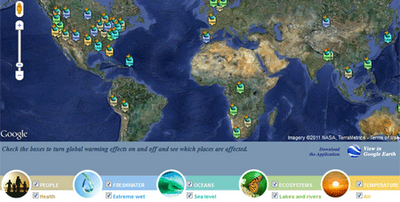
The Union of Concerned Scientists has created this Google Map to show the probable effects of global warming around the world. The map is accompanied by a Climate Hot Map Scavenger Hunt, which if you complete successfully gives you a chance to win a trip for two to the Rio Cachoeira Natural Reserve in Brazil.

The map explores the effect of climate change on people, the environment, the oceans, ecosystems and the temperature. You can select to explore any of these categories on the map using the menu at the bottom of the map.
Planefinder.net


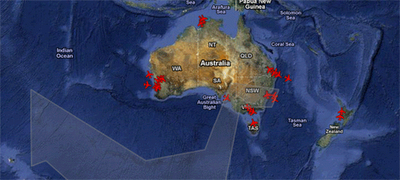
The ash cloud created by the eruption of the Puyehue volcano in Chile continues to cause huge disruption to plane flights in Australia. Real-time flight tracking website planefinder.net is using Google Maps to show the location of the ash cloud as it drifts around the southern hemisphere.

The ash cloud is predicted to linger over south-east Australia for some time, causing widespread disruption to flights in and out of Sydney and Melbourne. At the time of writing the planefinder.net map shows a few flights in and out of south-east Australian airports but nowhere near the flight activity that can be seen in and around Perth.
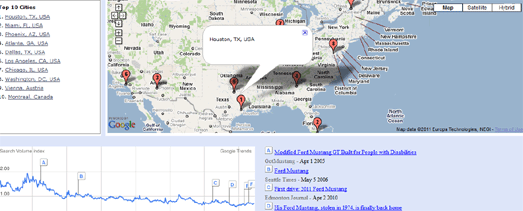
Mibazaar has created a Google Maps based application to explore where people are searching for a given keyword in Google Search.

In this demo of the application you can view where people are searching for different makes of Ford car around the world. For each make of car you can view the ten locations where the most people are searching for that Ford.

The map includes historical data so you can view how searches have changed over the years for each make of car.

Mibazaar – Google Trends – Ford
sailorsmap.com


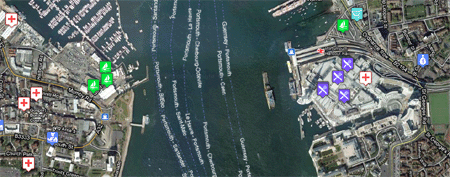
SailorsMap is a Google Map designed to help boat owners find useful places nearby.

Marinas and local stores that may be useful are added to the map on the fly. If your browsing device supports GPS then SailorsMap is automatically positioned at your current location.

As well as displaying nearby points of information, found via Google Maps Search the map, displays the nautical anchorages of Croatia.
Censo2010


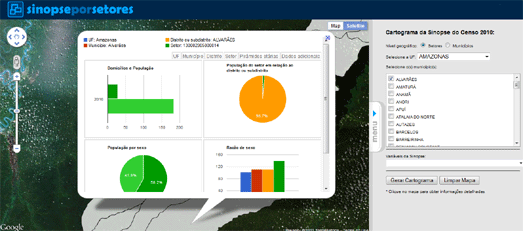
The Instituto Brasileiro de Geografia e Estatística has created an application that allows you to browse the results of the 2010 Brazilian census on a Google Map.

Using the application you can click on a census tract on the map and view demographic information collected in the census. The information includes the population, the percentage of men and women and the percentage of different age groups in the population.

Dotter Example – San Francisco Crime Map
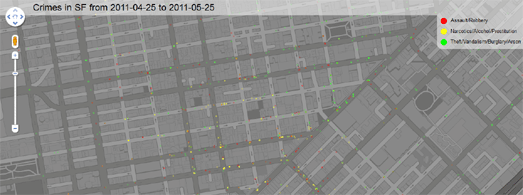

This Google Map displays 5000 crimes in San Francisco almost instantly on a Google Map. The map was created with the Google Maps API and the Dotter.js, a javascript class that generates data URIs.

The crimes displayed were committed in San Francisco between the 25th April and 25th May 2011. What is really impressive about the map is how quickly the 5000 data points load on the map.

If you want to create your own super-fast map with thousands of data points then the Dotter.js class is available on Github
Quake-Catcher Network


Many laptops these days are built with accelerometers that are designed to protect your hard drive from damage. The accelerometer detects sudden movement and can switch the hard drive off so that the heads don’t crash on the platters.

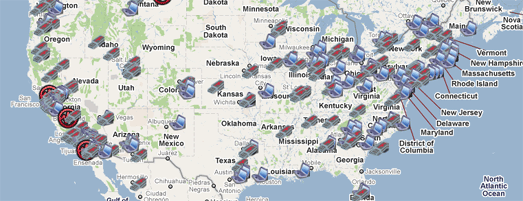
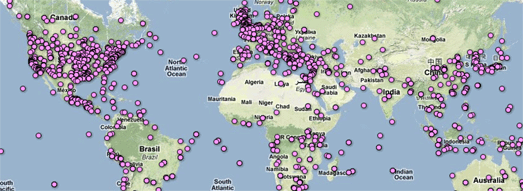
The Quake-Catcher Network realised that they could create the world’s largest and densest earthquake monitoring system simply by using the data from accelerometers in the world’s laptop computers. The Quake-Catcher Network links participating laptops into a single coordinated network that can detect and analyze earthquakes faster and better than ever before.

QCN uses Google Maps to show the data collected from participating laptops and from participating desktop computers with USB sensors. The map also shows the latest USGS reported earthquakes.
Live Call Map – OnSIP


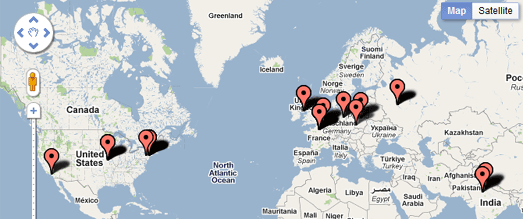
OnSIP, a provider of Voice over IP calls has released a real-time Google Map of calls made using its service.

The map makes nice use of the drop marker animation in the Google Maps v3 API. Each time an OnSIP customer makes or receives a call, a map marker is dropped on the live map, openly displaying call volume peak and trend information. A marker is dropped on the map every time an OnSIP customer makes or receives a call.
Map Channels


Map Channels, the popular Google Maps creation tool, now lets you add data to a map from Google Fusion Tables.

In the four years that Map Channels has been running over 20,000 maps have been created by its users. It has proved popular with casual map makers and with major news organisations., including Fox News and CBC.

You can create a Google Map with Map Channels using data from a KML, a Google Spreadsheet, a GeoRSS feed, tab delimited text and now with a Google Fusion Table. You can see an example of a Map Channels created map with data provided by a Fusion Table in this Wikipedia Events Map.
Postholer.com


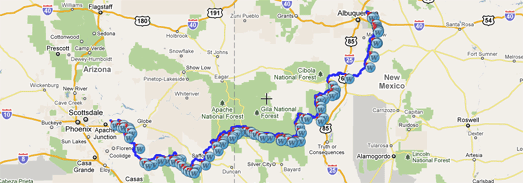
Postholer.com has created a Google Map of some of America’s most interesting trails. The map includes the route of the Appalachian Trail, the Pacific Crest Rail, the Continental Divide Trail and many more.

When you select a trail its route is displayed on the map. You can then select to view waypoints, points of interest, parking, camping spots and photos along the trail from a drop-down menu.

As well as providing a Google Map of the trails Postholer.com also provides a full set of printable maps for each trail.
Ofcom – Broadband Speeds Map

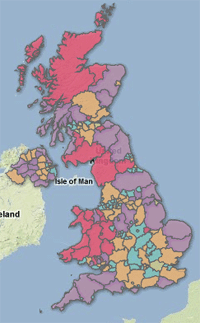
Ofcom, the regulator of the UK communications industries, has created a Google Map to show the speed of broadband throughout the UK.

Each county in the UK has been ranked on how they score on four broadband metrics; average sync speed, percentage getting less than 2Mbit/s, superfast broadband availability and broadband take up. The map displays as a basic heat map with each county coloured to show how they perform overall on each metric.

The map confirms what you already probably suspected. If you want superfast broadband then you are more likely to be lucky if you live in a big city. If you live in the Outer Hebrides then you are probably going to have make do with superslow broadband.


Cross from Google Maps Mania
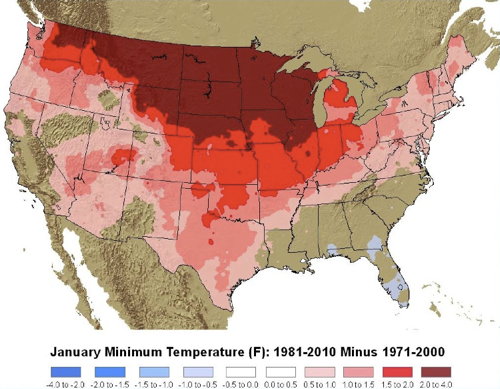
The New Normal Temperatures


NOAA Climate Normals: January Minimum Temperature (F): 1981-2010 vs. 1971-2000

Whenever I see a weather forecast, it’s usually accompanied by normal temperatures for the day. In NOAA’s case, that normal is calculated from a 30-year average, updated every decade. NOAA just updated those norms, Dan Satterfield reports, and as you might expect, things are a bit warmer: “Climate change is expected to be stronger in northern areas of North America and that trend continues to show up. It is also expected to be more noticeable at night and in winter and that too shows up clearly,” Dan says. Here’s a PDF of the NOAA briefing deck explaining the update, from which the map above is taken: the map shows the increase in degrees Fahrenheit between the 1971-2000 and 1981-2010 normal minimum temperatures for January. Via MAPS-L.

WeatherSpark Beta

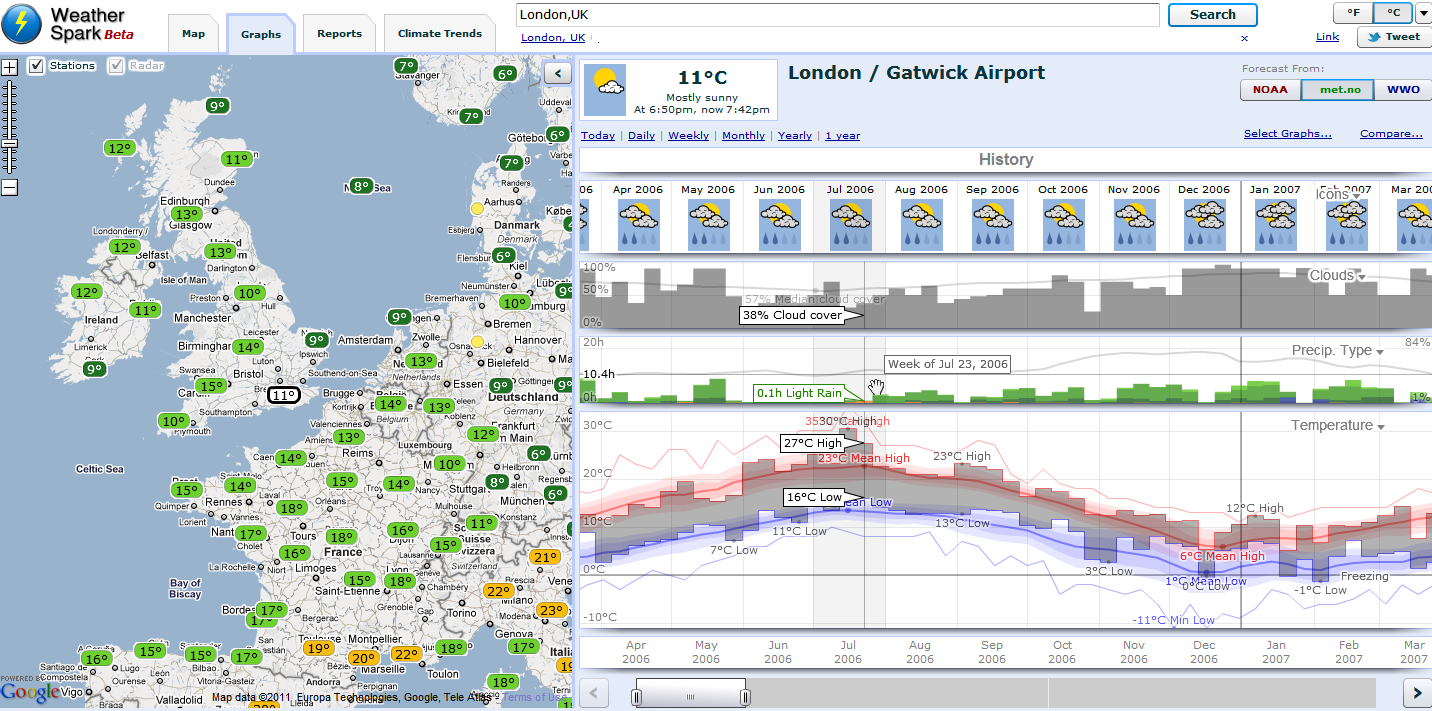
WeatherSpark Beta- Historical weather patterns visualised

An excellent Google maps mashup -an early contender for best gmap 2011.

WeatherSpark Beta

“WeatherSpark is a pretty amazing Google Map of current and historical weather conditions. The site lets you view the historical records of over 4,000 weather stations.”


example above
http://weatherspark.com/#!graphs;ws=28726;t=321909;mspp=37115493

Climate Patterns
WeatherSpark Climate Beta

If you are more interested in today’s weather you can just center the map on your location and view the current temperature and the current precipitation radar

http://weatherspark.com/#

source:
googlemapsmania

Learn about the human side of climate change with Kofi Annan

[Cross-posted on the Google.org and Official Google Blog]

Climate change is too often misunderstood to be simply an environmental issue, rather than a human issue. For our children and grandchildren, climate change is an issue of public health, economics, global security and social equity. This human side of climate change is explained in a new Google Earth tour narrated by former U.N. Secretary General Kofi Annan. Within these stories, you’ll find data and tools to explore this topic in more depth, and meet some of the people who are actively working on managing the risks of climate variability and change. We encourage you to take the tour to learn more about these human issues and the inspiring work of groups like the Alliance for a Green Revolution in Africa (AGRA) that are helping farmers cope with climate change. We hope this video will serve as a useful tool as educators help students around the world understand the complexity of this issue.

This is the latest in our series of climate change tours that we’re releasing leading up to the global U.N. Framework Convention on Climate Change (COP16) talks in Cancun, Mexico this week.

As part of the Google Earth for Educators Community, we’ve also created a special Climate Change Educators Resources page that teachers can use in their classrooms. Here, teachers can find the tools they need to create lesson plans about climate change, including all the individual Google Earth KML layers available for download. Teachers and students can overlay multiple data layers that help illustrate climate change, and discuss and analyze them as part of K-12 and higher education curriculum. We’re also looking for lessons plans for any school grade that use this narrated tour or these Google Earth KML layers, so if you’re a teacher or instructor, please submit your lesson plan for review now.


Visit google.com/landing/cop16/climatetours.html or the Climate Change Educators Resources page to learn more about climate change today.

Plant trees for change with Nobel Prize winner Wangari Maathai

(Cross-posted on the Official Google Blog)
Occasionally, we invite distinguished guests to contribute to our blogs and we’re very happy to have Wangari Maathai share her perspective here. In collaboration with Wangari Maathai’s Green Belt Movement and several other partners, the Google Earth Outreach team has created several narrated tours on the topic of climate change in preparation for the UNFCCC’s COP16 Climate Summit 2010 in Cancun, Mexico. Fly underwater to learn about the effects of ocean acidification on sea life with Oceana. Zoom around Mexican mangroves in 3D and learn about the importance of this biodiverse habitat… and what must be done to protect it for future generations. Visit google.com/landing/cop16/climatetours.html to experience these tours. -Ed.

Ask most people what trees mean to them and the first thing that comes to mind is the tree outside their bedroom window or the forest where they played as a child. Trees do occupy a powerful place in our emotions, but the most powerful argument to protect our world’s trees is not based on sentiment. There is a vital interdependency between communities and the trees they rely on for survival. Trees are our watersheds, protectors of the natural environment, and sources of food. Remove the trees from the equation and the community feels the impact.

I came to this realization in the 1970s in Kenya. I was talking to women in my community about their problems: hunger, access to water, poverty, wood fuel. I saw a link between their needs and the condition of the land and thought, “Why not plant trees to address these issues?” Trees hold the soil to the ground so that we can grow food in it, they protect watersheds and facilitate harvesting of rain water, fruits trees supplement food and trees give us domestic energy and wood with which to build our shelters. So while still working at the University of Nairobi, I established a tree nursery in my backyard, planted seven trees at a public park and founded the Green Belt Movement. The organization works to empower communities, to build their capacity to restore Africa’s forests and put an end to the problems that deforestation and other forms of environmental degradation cause. As a result of this idea, more than 40 million trees have been planted to restore the environment and improve the lives of the people who are linked to the land.

When we were offered a unique opportunity to partner with the Google Earth Outreach team on a project using new Google Earth technology to visualize trees in 3D, we were thrilled. For accuracy and integrity we worked very closely with Google, advising them on the modeling of unique African trees like the broad-leaved Croton, the Nile tulip tree and the East African Cordia. These tree models illustrate the biodiversity in our tree planting sites, especially in the forests, and how we carefully select trees that are indigenous and sustainable to the natural surroundings.

Broad-leaved Croton, the Nile tulip tree and the East African Cordia (from left to right)


We then used data from real planting locations to “plant” the tree models in Google Earth and create 3D visualizations. Now, for the first time in Google Earth, people from all over the world will be able to virtually visit these planting sites, explore the 3D trees and connect with the work that we are doing.

Green Belt Movement planting site in 3D on Google Earth


Tree planting is a simple activity with tangible results, and anyone can participate. It helps people come together to address common problems and work collectively towards community improvement and sustainability. I hope that seeing our beautiful tree planting sites in 3D on Google Earth will be a source of inspiration for people to engage, plant trees and organize planting activities in their own communities. Taking charge of our lives and the environment around us can help ensure a lasting legacy and healthy future for our children.

Learn more about the Green Belt Movement and support our work at http://www.greenbeltmovement.org.