How Google Earth is being used by the Philippine National Police


Over the years, Google Earth has been responsible for helping a huge number of non-profit and other worthwhile organizations around the world. We’ve shown you how environmental groups have been using Google Earth for more than six years, how it’s been used to fight against rainforest logging, and Google Earth Outreach consistenly showcases many other amazing organizations from a variety of countries.

Similarly to the others that have used Google Earth to fight against deforestation, the Philippine National Police have been using Google Earth to fight illegal logging in the province of Laguna.
 

map2.jpg 

Here is their story, in their words:

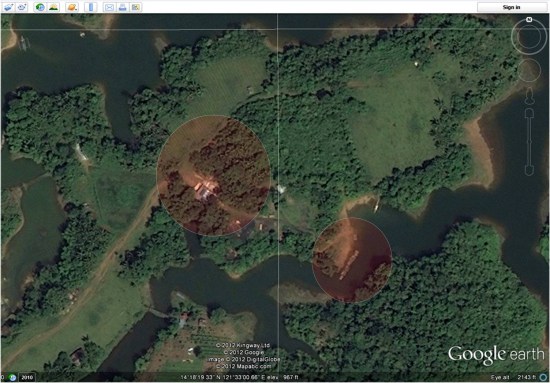
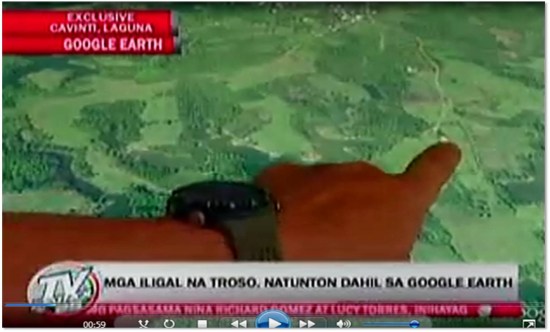
On behalf of all the personnel of Philippine National Police (PNP) Laguna, I would like to express our gratefulness for the wonderful gift of your Google Earth services. It contributed a lot and it has been a great part of our efforts against illegal logging here in the province of Laguna. Nationwide, we are shocked by the effect of the natural and man-made calamities wreaking havoc to our country resulting to loss of lives and properties. Man-made calamities are greatly attributed to rampant illegal logging and deforestation thus causing flash floods and landslides. Since Laguna had been one of the most affected areas of flash floods and landslides, the Laguna PNP initiated the creation of a dedicated Provincial Anti-Illegal Logging Task Group “BERDE” purposely to ensure the implementation of OPLAN “BERDE (Boost Economic Reserves for the Development of Ecosystem). Through the help of Google Earth, we were able to locate specific targets of our OPLAN BERDE. Our operations yielded positive results on illegal logging sites like Cavinti, Laguna that was identified by using Google Earth. Initial operation last April 13, 2012 resulted to the recovery of forest products, machinery equipment, tools and conveyance abandoned during apprehension. Google Earth has been a major contributing factor to the success of our operation. Because of you and your innovative services, we can keep moving forward towards the attainment of our goals in the field of law enforcement.

As Google Earth imagery continues to become higher resolution and update more rapidly, it will become an even more useful tool for organizations like this one.
 

Picture4.jpg 


Highlighting terrain by only showing the roads on the map


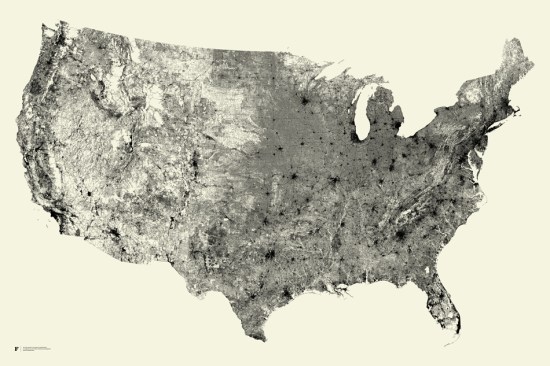
What if someone were to create a map that showed every street in the country and nothing else? Fathom Information Design did just that, and the results are amazing!


streets.jpg 

It feels kind of like the city lights of Earth that we recently wrote about, as you can clearly see cities form without any kind of borders or other overlays in there.

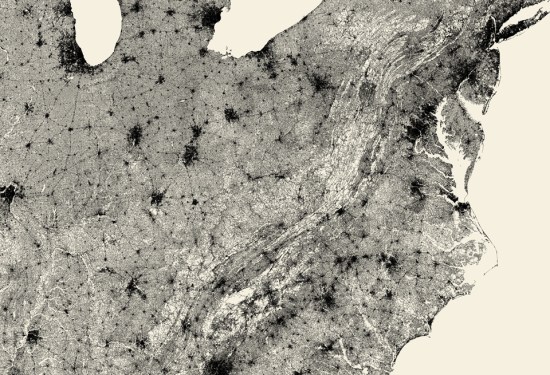
What’s even more remarkable about the “All Streets” map is how clearly the mountain ranges are defined. Simply by drawing in the roads, you can see them without any difficulty. A great example is the Appalachian Mountains, seen here:


appalachian.jpg 

You can view and/or purchase the map over on the Fathom website.

(via +Adrienne St. Aubin)

Searching closer

The global trends revealed in 2011 year-end Zeitgeist. In addition to looking broadly at topics from more than 40 countries around the world, the site included the most popular local terms from more than 30 major cities in the United States. Looking at these lists, I was surprised to see that, from city to city, almost all the terms across all the lists were related to local news, education, civic services or entertainment and activities. I wanted to take a minute to take a deeper dive into these specific local trends that you won’t see published in Zeitgeist.

In nearly every single U.S. city we looked at, the top ten local terms showed that people were using Google to find local news stations and learn more about educational organizations. Searches for school districts, universities and local libraries made the list in ten states, from the Hennepin County Library in Minneapolis, MN to the Chicago Public Library in Illinois. Pittsburgh, PA was the most media-hungry city in Zeitgeist this year, with all of their top 5 terms related to local news stations, while in New York City and Houston, TX, no news sources made the top ten lists.

The data also showed some interesting regional differences within single states as well. Orlando, FL was a leading city in terms of education, with related terms making up 40% of the list. But in Miami, less than 250 miles away, no education-related terms made the list. While local TV station WRAL came in at the top of the list in Raleigh, NC, people three hours away in Charlotte bumped the station to their #3 spot, behind the local Charlotte Observer, which came in at #1.

People in many U.S. cities were also using Google to connect with civic services, from the Maricopa County Assessor in Phoenix, AZ to the Cuyahoga County Auditor in Columbus, OH. We also saw many terms related to public transit and traffic, which was of particular interest to residents of Los Angeles, who put SigAlert, the California Highway Patrol’s traffic report site, as the #1 most popular local term. The city most concerned with getting out and about, though, was New York, where the top four search terms were all related to transportation, be it by subway, train or car.

With national unemployment in the United States above 9% for most of the year, there was a strong interest in unemployment and finding jobs locally. The term unemployment came up on lists in Kansas City, Philadelphia and Portland, OR, and in total more than ten of the 31 cities we looked at had a term related to unemployment or job-seeking on their list. In Detroit, MI and Houston, TX, the only two cities where two unemployment-related terms made the top ten, Google searchers were also taking initiative, looking at job posting sites like the Michigan Talent Bank or classifieds like Greensheets to try and find their next job online.

The local lists didn’t just reflect hard times. Nearly every city had a mall, fair, amusement park, sports team or other fun activity or destination in the top ten (the only holdout was Washington D.C.). Indianapolis, IN and Phoenix both had their respective lotteries in the number three spot—looks like lots of people there were feeling lucky! Across the country, Americans also looked for ways to relax, from restaurant week in Boston to the Lenox mall in Atlanta and Summerfest in Madison, WI.

The searches people make are a fantastic pulse on what is happening around the world and close to home. We pay attention to what you’re looking for so we can come up with new and better ways to help you find it, no matter where you’re searching from.

Map Maker: from Afghanistan to Antarctica

Google Map Maker enables local experts to create maps and share their local knowledge with the world. These citizen cartographers help keep maps of their areas accurate and up to date. They add missing roads and new businesses—and even map areas that have little to no data yet on Google Maps.

Today, our latest crop of countries, territories and an entire continent are graduating from Map Maker—meaning the user-generated maps of these countries will now appear on Google Maps: Afghanistan, Antarctica, Ecuador, Georgia, Guatemala, Heard Island and McDonald Islands, Honduras, Iraq, Norfolk Island, Saint Pierre & Miquelon and Saudi Arabia.

Here are some before and after pictures that highlight how much detail Map Maker users have added to Google Maps for these regions (as well as some time-lapse videos):

Baghdad, Iraq

Kabul, Afghanistan

Tbilisi, Georgia

Each region has an impressive mapping story—from the Georgian Government’s initiative to improve their country’s map, to the group led by six students in Herat, Afghanistan who mapped their entire city in a matter of weeks.

Thank you to the Google Map Maker contributors who create better maps for these regions and others; their ongoing efforts can be seen at Map Maker Pulse. We encourage all local mappers to continue improving the maps of these areas and the more than 180 other regions of the world on Google Map Maker.

Mapping the football searches

Fall means lots of things in the United States: leaves changing colors, apple picking, back to school and…football. This weekend, the National Football League (NFL) starts its season with a bang, with 15 games on Sunday and Monday. College and high school football are already underway and fans all across the country are tuning in, getting excited and rooting for their teams—in person, on television and online. As a Notre Dame alum (class of ‘87), the ups (and the recent downs) of Fighting Irish football are always a big part of my fall weekends. Regardless of your alma mater or hometown team, one thing is certain: American football is a big deal across the United States. Ahead of most of this week’s kickoffs, we thought it would be fun to take a peek at some of the football search trends from around the country.

There’s some debate as to what is more popular: professional (NFL) football or college football. Search queries make it clear that in spite of the [nfl lockout], the pro game and [nfl] is consistently more popular for U.S. searchers than all of [college football].

That doesn’t mean that the college game isn’t extraordinarily popular. Right now, we’re seeing the highest level of search queries for [college football] since 2004. In certain regions, college football appears to be king over even the NFL. The states with the most searches for [college football] are mostly in the southern part of the country, with the notable exception of the rabid fans of the Nebraska Cornhuskers. That’s no wonder—on Saturdays, when the Huskers are playing at home, their Memorial Stadium becomes the third largest “city” in the state.

We can also conduct a little popularity contest among players in college football. The Heisman Trophy, awarded annually to the top college player, is usually correlated to spikes in search query volume. This year, the early favorites for the Heisman are beginning to take shape. Stanford’s quarterback [andrew luck], who opted to play his senior year in college instead of heading to the pros, is out front in terms of searches, but fans should also watch out for Robert Griffin III from the Baylor Bears program. [rg3], as he’s known, had the game of his career in week one and might be the national breakout star of the first few weeks of the season.

Over on the NFL side, it appears that winning the big game has little relation to how often people search for their favorite player. In the past month, the most searched for player in the NFL is [peyton manning] of the Indianapolis Colts, who last won the Super Bowl in 2007. He’s currently sidelined with a neck injury, so his status is likely driving much of the current search queries. Meanwhile, the quarterbacks from the past two Super Bowl winners, [drew brees] from the New Orleans Saints and [aaron rodgers] of the Green Bay Packers, come in behind a player who isn’t even his team’s starter: Denver Broncos QB and former Florida Gators star [tim tebow].

The old saying goes, “on any given Sunday,” meaning that every team has a chance to win each time they hit the field. The adage manifests itself in typically balanced standings that last throughout the season and into the playoffs. But when it comes to search, we’re not quite so fair and balanced. In fact, there’s a clear favorite, and by this measure they really are “America’s Team”: the [dallas cowboys]. In the U.S., the Cowboys lead all other teams in search query volume, followed by the [chicago bears] and the [green bay packers].

No examination of football search trends would be complete without mentioning Fantasy Football. Millions of fans participate in their own drafts and watch their league’s waiver wires as they serve as coach and general manager for their own fantasy team. The enthusiasm is so fevered that, in the U.S. right now, more people are interested in [fantasy football] than President [obama].

Finally, for spectators, football isn’t just about teams and players. It’s also about the game day food. [Tailgating] searches peak every fall as folks turn to the web to discover new recipes and ideas for pre-game parking lot cookouts. The Super Bowl in February really drives gameday recipe searches, but tailgating staples like [guacamole], [wings] and [brats] all rank high in terms of search quantity every fall, with the king of all tailgating recipe-related searches being [dip].

Whether you’re an NFL fan, an NCAA nut or just someone who likes hot wings, here’s to a great season.