Mapping the football searches

Fall means lots of things in the United States: leaves changing colors, apple picking, back to school and…football. This weekend, the National Football League (NFL) starts its season with a bang, with 15 games on Sunday and Monday. College and high school football are already underway and fans all across the country are tuning in, getting excited and rooting for their teams—in person, on television and online. As a Notre Dame alum (class of ‘87), the ups (and the recent downs) of Fighting Irish football are always a big part of my fall weekends. Regardless of your alma mater or hometown team, one thing is certain: American football is a big deal across the United States. Ahead of most of this week’s kickoffs, we thought it would be fun to take a peek at some of the football search trends from around the country.

There’s some debate as to what is more popular: professional (NFL) football or college football. Search queries make it clear that in spite of the [nfl lockout], the pro game and [nfl] is consistently more popular for U.S. searchers than all of [college football].

That doesn’t mean that the college game isn’t extraordinarily popular. Right now, we’re seeing the highest level of search queries for [college football] since 2004. In certain regions, college football appears to be king over even the NFL. The states with the most searches for [college football] are mostly in the southern part of the country, with the notable exception of the rabid fans of the Nebraska Cornhuskers. That’s no wonder—on Saturdays, when the Huskers are playing at home, their Memorial Stadium becomes the third largest “city” in the state.

We can also conduct a little popularity contest among players in college football. The Heisman Trophy, awarded annually to the top college player, is usually correlated to spikes in search query volume. This year, the early favorites for the Heisman are beginning to take shape. Stanford’s quarterback [andrew luck], who opted to play his senior year in college instead of heading to the pros, is out front in terms of searches, but fans should also watch out for Robert Griffin III from the Baylor Bears program. [rg3], as he’s known, had the game of his career in week one and might be the national breakout star of the first few weeks of the season.

Over on the NFL side, it appears that winning the big game has little relation to how often people search for their favorite player. In the past month, the most searched for player in the NFL is [peyton manning] of the Indianapolis Colts, who last won the Super Bowl in 2007. He’s currently sidelined with a neck injury, so his status is likely driving much of the current search queries. Meanwhile, the quarterbacks from the past two Super Bowl winners, [drew brees] from the New Orleans Saints and [aaron rodgers] of the Green Bay Packers, come in behind a player who isn’t even his team’s starter: Denver Broncos QB and former Florida Gators star [tim tebow].

The old saying goes, “on any given Sunday,” meaning that every team has a chance to win each time they hit the field. The adage manifests itself in typically balanced standings that last throughout the season and into the playoffs. But when it comes to search, we’re not quite so fair and balanced. In fact, there’s a clear favorite, and by this measure they really are “America’s Team”: the [dallas cowboys]. In the U.S., the Cowboys lead all other teams in search query volume, followed by the [chicago bears] and the [green bay packers].

No examination of football search trends would be complete without mentioning Fantasy Football. Millions of fans participate in their own drafts and watch their league’s waiver wires as they serve as coach and general manager for their own fantasy team. The enthusiasm is so fevered that, in the U.S. right now, more people are interested in [fantasy football] than President [obama].

Finally, for spectators, football isn’t just about teams and players. It’s also about the game day food. [Tailgating] searches peak every fall as folks turn to the web to discover new recipes and ideas for pre-game parking lot cookouts. The Super Bowl in February really drives gameday recipe searches, but tailgating staples like [guacamole], [wings] and [brats] all rank high in terms of search quantity every fall, with the king of all tailgating recipe-related searches being [dip].

Whether you’re an NFL fan, an NCAA nut or just someone who likes hot wings, here’s to a great season.

The great Football resources in Google Earth


With NFL and NCAA football both in high gear, we thought we’d take a look at various football-related resources in Google Earth.

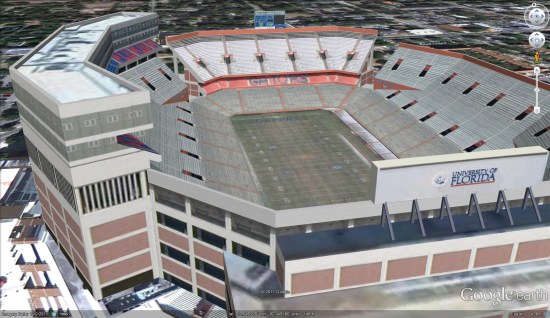
A few years back, Google showed off all of the 245 NCAA football stadiums, many of which are in 3D. You can explore them yourself using this KML file.


florida.jpg 

Another way to see them is by viewing some of the stadium collections on EarthSwoop, which allow you to fly from stadium to stadium via the Google Earth Plug-in: ACC, Big Ten, Big 12, PAC 10, SEC and the entire NFL.

Speaking of the NFL, it’s worth checking out Cowboys Stadium in Dallas. It hosted the Super Bowl earlier this year, and it’s an amazing model. If you’re looking to play some football, you can check out the Google Earth-based football game that I created a few years ago. I’m sure it could be done better with the Google Earth Plug-in now, but it’s still pretty fun.

Jordan on Failing to Succeed

“I’ve failed over and over and
over again in my life. And that is
why I succeed.

–Michael Jordan (1963 – )
American basketball player

The 2011 NCAA Men’s Basketball Tournament concludes on Monday with the Final Four starting tomorrow night (04.02) at 6 pm EDT.

The quote above is from a commercial by Nike (30 seconds). When you need a well-earned break, enjoy this 4.5 minutes with Michael Jordan in “What is Love?” Great even if you’re not a basketball fan.
_____

Google Earth: Baseline to baseline, we’ve got the basketball games covered

Do you hear the dribble on the court and the chanting of the fans? Following an action-packed week of buzzer beaters, the 2011 NCAA® Championship here in the U.S. promises to be as exciting as ever.

As a college hoops fan, I often wish I could experience the games sitting in the arenas—and I’m sure I’m not alone. This year, our college basketball tournament map lets you get as close as you can to the games without leaving your desk thanks to 3D models of the tournament’s 14 arenas. Take a virtual tour of the venues by watching the video below, or download this tour and open it in Google Earth.

Plus, we’ve created a special page for you to keep track of all the excitement during the next few weeks. You can see an up-to-date tournament schedule, explore the college campuses in Street View and click through to watch the actual games on NCAA® March Madness on Demand®. You can also create a bracket using Google Docs, read Google News articles on the games and download basketball apps from the Chrome Web Store. It’s all here (along with a fun surprise) at www.google.com/collegebasketball2011.

And since there’s been a long-running debate over whether teams playing closer to their home court have an advantage, we added a “Distance Tool” on the map to make it easier to measure how far schools have to travel from game to game. We’ll see how things play out, but the defending champion Duke Blue Devils may have to travel more than 2,000 miles to Anaheim if they win their first two games.

As my friends always say when we can’t wait for the tournament to begin, “Send it in, Jerome!” May your favorite school reach the finals and we hope you enjoy all the basketball fun at www.google.com/collegebasketball2011.

Posted by Aaron Weissman, Google Maps Marketing (San Francisco King of the Rock winner)

MapQuest Finally Goes OSM in USA

So apparently our work is done in the USA with the OpenStreetMap data because MapQuest opened up their USA version of their open initiative.

Open.Mapquest.com provides the same features as our 10 sites in Europe and Asia, and also debuts a new error-reporting tool (which has been added to all of MapQuest’s open sites).  For many, this tool may be their first step in becoming OSM contributors.  Now, on any open MapQuest site, errors can be reported directly and are displayed in near real-time.  These errors can range from an incorrect speed limit or directional changes on a street to a missing parking lot or a new cultural institution.

Bing Boom goes the dynamite!  I guess now we can’t complain about the quality of the map anymore because it is my own fault it sucks in Arizona.  This is a very gutsy move on MapQuest’s part as I’m not sure the map is really good enough to use in the United States, but we need something like this out there to get it moving forward.  Rather than fix errors in the Google Map, now we can fix errors in the MapQuest Map and send them on to the root OSM map.  Good work MapQuest!

As an Arizona State alumni, I’m planning a trip to see the NCAA this weekend to correct a horrible wrong done to our fair university.  Looks like I’ll be making that trip with MapQuest and OSM.