Google+ Local


Last week’s announcement of Google+ Local was underwhelming. The review upgrade was impressive but the rest was tepid at best. Essentially the URL for your Place page has changed and the page now shows in the index although it seems to have broken more than it fixed. The announcement last week of Google+ Local was more important for what was left out than what was in it.

We know that Google has been gradually diassembling the Dashboard (pulling out AdWords Express and revamping Offer Coupons) and that its functionality has not been updated in eons (think analytics that only report out pack results NOT blended).

The current move of the business listing from Places to Google+ Local essentially broke the ability of the Dashboard to view the listing and the listings no longer indicates that the business has claimed them or that it is verified.

We also know for sure that the Google +Local page will merge into the G+ Business page in the near future. Clearly Google is focusing its energies on integrating as much as possible into the social backbone of G+.

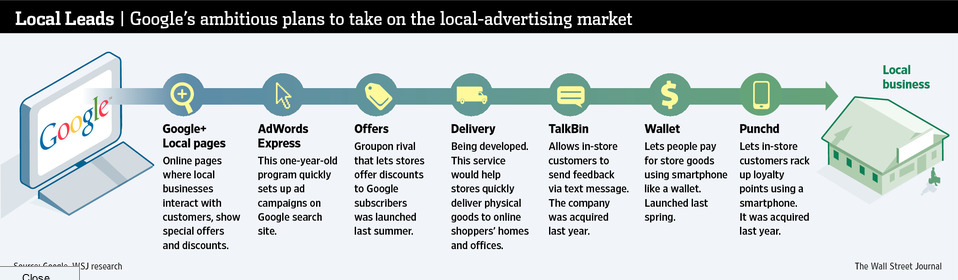
Over the past year Google bought Zagat but they also bought local online services Punchd (a digital loyalty program) and Talkbin (an SMS based) CRM program. Both programs that have a strong potential appeal in the local market. In the recent rollout we see a glimmering of using the business listing as a local transaction engine with the inclusion of OpenTable.

When you add all of that up you come to the inescapable conclusion that the backend Dashboard is undergoing a massive rework and will likely become a central point for the SMB to interact with all of Google’s products with a special emphasis on Google Plus.

David Mihm has written about a vision of what the Dashboard could and should become. Bing has implemented a blueprint for an integrated marketing portal that might also provide a guide to Google. Whatever it is it will need to be more engaging, more valuable and more integral to local businesses ongoing marketing needs: better analytics, simple integration with G+, CRM, easy opt-in to Google’s paid products, the ability for the business to easily understand and interact with a full range of Google’s local offerings and the ability for Google to plug in more functionality down the road.

Today the Wall Street Journal today essentially confirmed this direction. They note that by early July Google will be rolling out such a product:

The project combines several products and services aimed at small businesses under a single banner. It is based on a mix of internally developed software and recently acquired technologies that the company hopes eventually will bring in billions of dollars a year in new revenue.

Central to the effort is Google+, the company’s social network, which it hopes consumers will use to interact with local businesses that now have special Web pages on the network. Those Google+ pages will draw traffic from the company’s Web-search engine. When shoppers visit these businesses, Google wants them to use their Internet-connected phones like a digital wallet, earning loyalty points and making payments at stores that sign up for Google’s new services.

When this occurs the real Google+ Local will be rolling out, not just a new location for a landing page, but a substantial improvement to the static and marginally functional Dashboard. Let’s hope that it is an integrated marketing solution that is elegant, provides significant on-going value and works properly right out of the gate (oh and is multiuser).
 

Google+: Improvements before the New Year

Google announce a goodie basket full of Google+ features and functionality for you to unpack and enjoy over the holidays. Some of these were on nearly everyone’s wishlist… and some we hope will be welcome surprises. These features will be rolling out over the next couple of days, and we hope you’ll find them useful this holiday season and beyond.

Pump up (or down) the volume!
Sometimes important posts you wouldn’t want to miss from close friends or family can get lost amongst posts from others who post dozens of times a day. We’re adding fine-grained controls that will enable you to “graphic-equalize” and fine-tune your stream. When viewing the stream for a particular circle, you’ll now see a slider at the top that lets you adjust how posts from that circle should be blended into the main stream. That way you’ll never miss a post from that special someone, and you can tweak these settings to form your own “perfect stream.”

More useful and attractive notifications
One of the most useful and valuable features of the redesigned Google bar is the red notifications indicator. (You could even say it glows!) You know when you have tasty social content to consume, but the notifications themselves have been a little cryptic, often requiring you to navigate to the content itself to understand what happened. We now have easy-to-read “sneak previews” that immediately present what’s new and why you might care. We’ve polished these notifications up and made a few other meaningful improvements too, including the ability to see the +1’s and shares your posts have received since you last checked.

Google+ Notifications

Improvements to Google+ Pages
Google+ Pages have already provided brands and businesses a new means of connecting to and deeply engaging with consumers. In the weeks since launching pages, we’ve been listening to your feedback and we’re pleased to make some of the most oft-requested features available.

  • You can now delegate up to 50 named managers as administrators for a page.
  • A new notification flow will ensure that these managers stay in the loop on all the activity that takes place on a page, giving managers the ability to stay involved in page conversations.
  • We’ll now show an aggregated count of users that have engaged with your page, either by +1’ing it or by adding it to a circle. This way, both you and your page’s visitors can get an at-a-glance summary of who is interacting with your page.

A more beautiful and usable photos experience
Finally, we’re making a bevy of improvements to the Google+ Photos experience, just in time for the holiday photo-sharing season. Viewing a photo in Lightbox has been completely redesigned with improved navigation, enhanced comment legibility and better overall utility. This design makes the photo the hero, letting the content itself shine through. And we’re introducing a completely new photo-tagging experience that’s both fun and fluid, and lets you quickly focus on the people in your photos.

We hope that you enjoy these improvements and continue to provide us feedback. It’s been an incredible year for us on the Google+ team. While this indeed has been a #seasonforshipping, Google+ users know that we believe that shipping is always in season!

via: Google Official

SightSpace 3D

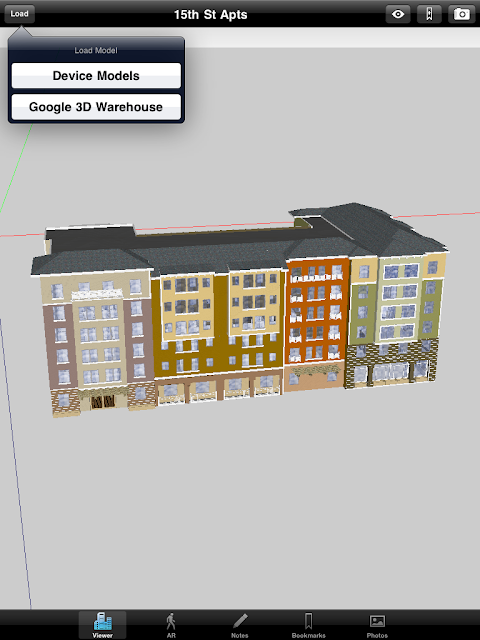
Have you ever wanted to take your SketchUp models on the go? Our friends at the Boulder-based start-up, Limitless Computing, have a solution for you: their recently released SightSpace 3D app allows you to view SketchUp models on the iPad, iPhone, or iPod (Android support coming soon).
I gave it a whirl and the viewer is quite good. Orbiting a SketchUp model with single finger, panning with two, and pinching to zoom in and out is very satisfying. Loading models onto your mobile device is easy too; the Google 3D Warehouse is integrated in the app and you can also load models through Dropbox and email.

The 3D Warehouse is integrated into the app making it easy to load models

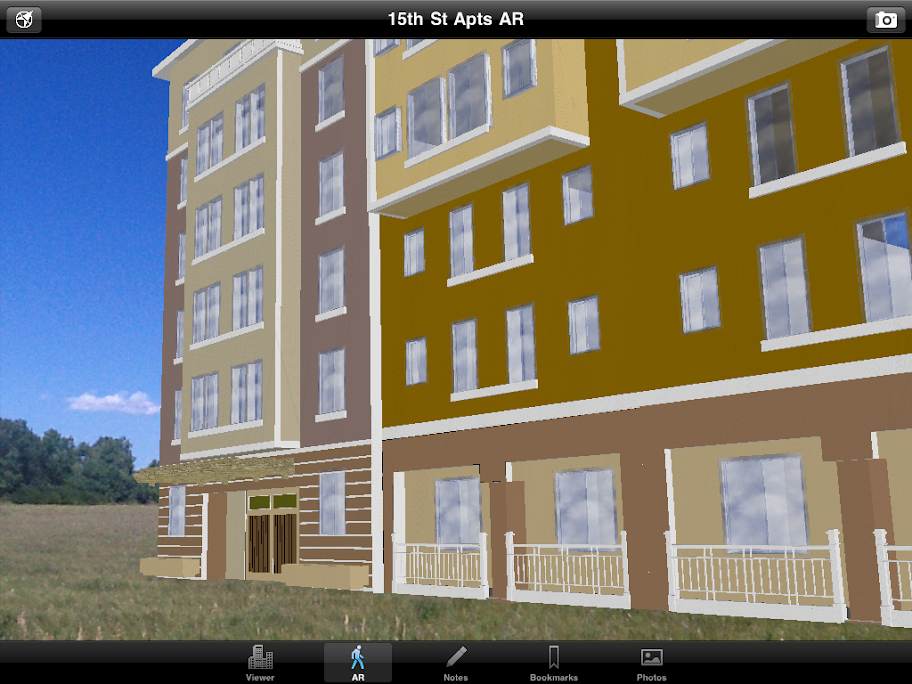
The mobile viewer would be neat enough, but SightSpace 3D’s killer feature is the Augmented Reality (AR) viewer, which gives you the ability to overlay 3D models onto the physical world. Any geo-located Google SketchUp model can be exported to a KMZ file, placed on an iPad 2 or iPhone 4, and viewed in real-time, in a real place letting you actually walk through the space. As you can imagine, this is useful for previewing construction projects, displaying kitchen designs, urban planning and much more.

An apartment complex is superimposed on undeveloped land, to scale. (Model courtesy of Hilliard Architects, San Francisco, CA)

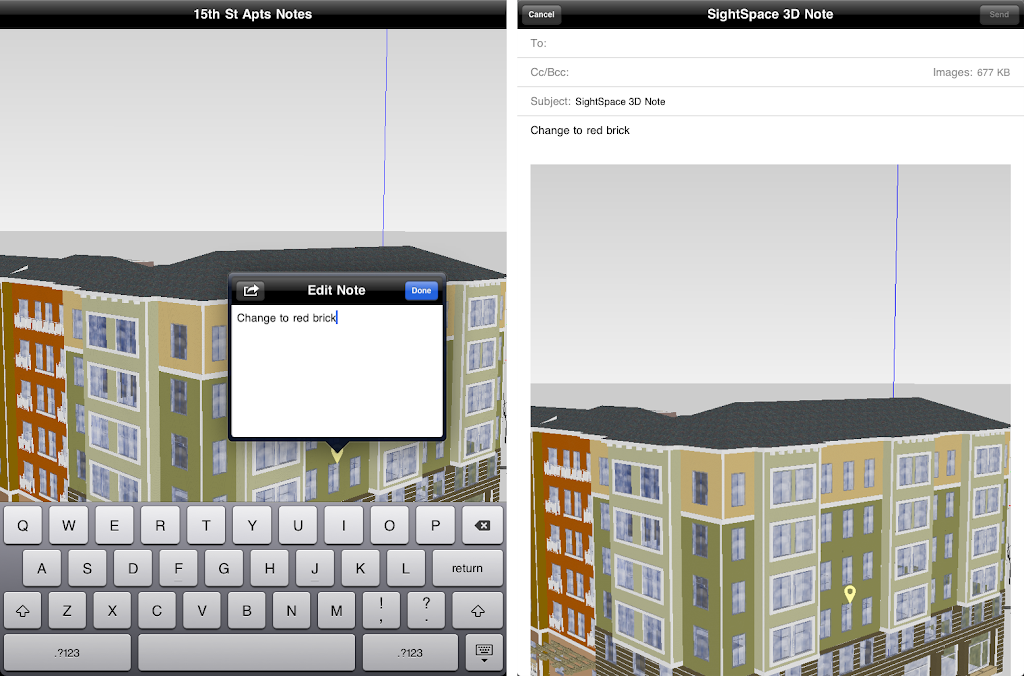
Additional features include bookmarking views, taking snapshots in both Viewer and AR mode, and the ability to annotate and email notes directly from the app.

Annotations and photos of a model get added directly to an email

SightSpace 3D is available now in the iTunes store now for $15 US, so go download it today.

How to export to KML from the new Google Maps?


As part of the recent Google Maps redesign, the ability to export your map to KML was mistakenly removed. According to a post in the Google Maps support forum, the feature will be added back in to Google Maps as soon as possible. In the meantime, here’s a workaround for you:

1 — Set the map the way you’d like it.

2 — Click the “link” icon in the top right corner.

3 — Copy the link below the “Paste link in email or IM”.

4 — Paste the address into your address bar and then add &output=kml to the end of it.

The image below helps explain how steps #2 and #3 work:

export-map.jpg 

No timeframe was given for the return of the KML link, but I expect they’ll fix it fairly soon. Let us know if you have any trouble getting this workaround to work for you.

The New GeoServer 2.1

GeoServer 2.1 (Major Update)

“GeoServer is a Java-based software server that allows users to view and edit geospatial data. Using open standards set forth by the Open Geospatial Consortium (OGC), GeoServer allows for great flexibility in map creation and data sharing.”


18 months in the making:
WMS Cascading

New Features

Something many users have asked for since the very addition of WMS support is cascading, the ability of GeoServer to proxy for another remote WMS server (be it GeoServer, MapServer, or ArcGIS). This feature has many uses, such as pulling in a remote base layer and overlaying local vector data onto it or securing a locally unsecured map server. Special thanks to the University of Perugia for sponsoring this feature.

Virtual Services

Anyone who has published a large number of layers or feature types with GeoServer has probably at some point been annoyed by the fact that every single layer is published by a single global service. WMS has the ability to group and nest layers but WFS and WCS have no such equivalent. Thanks to virtual services, one can create multiple service endpoints within a single GeoServer instance. Special thanks to Landgate for funding this work.

Layers from SQL

GeoServer has always been good at publishing a flat database table but users often need to do more—such as pre-filter the data in a table, join two tables together, or generate column values on the fly with a function. Before this feature, the recommendation was to create a view, yet views can be a maintenance burden and are at times problematic.

Now one can create a layer directly from an SQL query and query definitions can be parameterized to create dynamic queries on the fly. These parameters can be restricted with regular expressions to prevent an SQL injection security hole.

Special thanks to Andrea Aime for spending much of his personal time on this one and to OBIS for providing the funding for the parametric component of the work.

Web Processing Service (WPS)

With 2.1 and the arrival of WPS we welcome a new OGC service into GeoServer. The Web Processing Service is an OGC service for performing geospatial analysis functions over the web. The specification is extensible in nature and allows for simple processes ranging from buffering a geometry to more complex processes such as image processing.

Historically, GeoServer has been focused on data delivery and did not provide tools for performing analysis on spatial data. WPS fills that gap, making GeoServer a more compete solution for geospatial web services.

Thanks to Refractions Research for the initial contribution of the WPS module and to Andrea once again for taking personal time to bring WPS support to its current state.

Unit of Measure

Support for units in SLD allows one to specify values in measurements other than pixels such as feet or meters. This adds a very powerful capability to SLD that may alleviate the need for multiple scale-dependent rendering rules and may greatly simplify complex SLD documents.

Special thanks to Milton Jonathan for the initial GeoTools work to make unit of measure support possible and to Andrea for working with Milton to improve the initial patch. Note that this feature has also been backported to the stable 2.0.x branch thanks to support from SWECO and Malmö City of Sweden.

DPI Scaling

GeoServer renders images at a resolution of 90 DPI by default. While this is acceptable for most standard screen resolutions, it is unacceptable for higher-resolution printed materials. Now it is possible to supply a format option to a WMS request to control the DPI setting on the fly.

Special thanks again to SWECO and Malmö City of Sweden for sponsoring this work. Note also that this feature has also been backported to the 2.0.x branch.

Graphical File/Directory Chooser

Ever found it difficult to remember the full path when loading a shapefile or GeoTIFF? This new improvement brings an easy graphical file and directory selection tool for browsing the file system on which GeoServer resides. This is definitely a great enhancement to make GeoServer even easier to configure.

Core improvements to support a database-backed catalog

GeoServer’s core catalog interfaces received some tweaks to more easily support different backend storage formats. The current in-memory implementation has a number of drawbacks—the most notable being that it is memory-bound, meaning it cannot scale to accomodate large numbers of layers. Support for specific new storage formats is still only available as a community module but these core improvements make it possible to more easily swap between different backends.

Font Improvements

Adding new fonts to maps should now be much easier, as one can drop font files directly into the GeoServer data directory and have them be recognized by GeoServer. The admin interface will list all fonts that are currently available, including those made available by the Java Virtual Machine.

Upgrade to Spring Security 2.0.6

GeoServer has always had Acegi Security at its core but since that library was absorbed by the Spring community it has been improved and upgraded into Spring Security, the official security module of the Spring portfolio. This brings a number of new security protocols to GeoServer, including OpenID and Windows NTLM. With even more powerful options, it should now be easier to customize the security setup.

WCS Limits

While WFS and WMS have both had the ability to limit what a user can request, now similar controls are in place for WCS calls as well. Thanks to MassGIS for funding this improvement.

WMS 1.3.0

WMS 1.3.0 is the newest version of the Web Map Service protocol. Special thanks to Ordnance Survey, Britain’s national mapping agency, for providing OpenGeo with funding to complete its implementation in GeoServer. With WMS 1.3 mandated by the INSPIRE Initiative, Ordnance Survey opted to fund the GeoServer project so that other organizations in the UK and the rest of Europe could meet their INSPIRE requirements and everyone across the globe could benefit.

SLD 1.1 / SE 1.1 enhancements

Though not every new option is fully-supported, it is now possible to use most SE 1.1 documents in GeoServer. User feedback on which new options should be supported first is greatly appreciated. Also funded by Ordnance Survey is a community module to implement the WMS extensions for INSPIRE View Service compliance—namely the language parameter and several extended capabilities fields.

GeoWebCache Integration

GeoWebCache integration allows clients to enjoy the benefits of tile caching through the regular GeoServer WMS endpoint. This enables GeoWebCache to transparently proxy for the GeoServer WMS without the need for a separate service endpoint. Taking advantage of the recently-added disk quota functionality, GeoWebCache now provides the ability to set limits on the amount of disk space used for storing tiles, allowing users to control and limit the size of the tile cache on disk. Big thanks to Gabriel Roldán of OpenGeo for the great GeoWebCache improvements.

Improvements to RESTConfig

This release also brings some improvements to RESTConfig, which is now shipped with GeoServer by default. Improvements to the API include a file upload operation that now allows for uploading files into an existing data store. This addition allows users to upload a shapefile and have it automatically converted into a PostGIS database and published as a PostGIS layer rather than as a Shapefile layer. The API also supports recursive DELETE operations, making it more convenient to remove resources that contain other resources such as stores or workspaces. Thanks to David Winslow and Justin Deoliveira of OpenGeo for these improvements.

Improved Raster Reprojection Performance

Thanks to some great work from GeoSolutions, raster reprojection performance has been significantly improved by using linear appoximations of transformation functions.

WCS Request Builder

Thanks to Andrea Aime, there is now a Web Coverage Service request builder for graphically building WCS requests to test a coverage service. As clients for WCS have always been sparse, this tool goes a long way towards making the service more usable.

Run multiple GeoServer instances from a single data directory

There now exists a new parameter that will once again allow multiple GeoServer instances to run from a single data directory. This parameter, named “GWC_DISKQUOTA_DISABLED”, will disable the GeoWebCache disk quota module and prevent it from maintaining a lock on the data directory.

Source:
http://blog.geoserver.org/2011/05/12/geoserver-2-1/