Google+ Local


Last week’s announcement of Google+ Local was underwhelming. The review upgrade was impressive but the rest was tepid at best. Essentially the URL for your Place page has changed and the page now shows in the index although it seems to have broken more than it fixed. The announcement last week of Google+ Local was more important for what was left out than what was in it.

We know that Google has been gradually diassembling the Dashboard (pulling out AdWords Express and revamping Offer Coupons) and that its functionality has not been updated in eons (think analytics that only report out pack results NOT blended).

The current move of the business listing from Places to Google+ Local essentially broke the ability of the Dashboard to view the listing and the listings no longer indicates that the business has claimed them or that it is verified.

We also know for sure that the Google +Local page will merge into the G+ Business page in the near future. Clearly Google is focusing its energies on integrating as much as possible into the social backbone of G+.

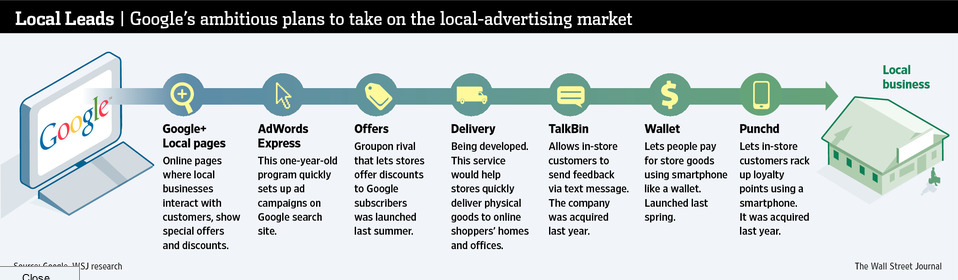
Over the past year Google bought Zagat but they also bought local online services Punchd (a digital loyalty program) and Talkbin (an SMS based) CRM program. Both programs that have a strong potential appeal in the local market. In the recent rollout we see a glimmering of using the business listing as a local transaction engine with the inclusion of OpenTable.

When you add all of that up you come to the inescapable conclusion that the backend Dashboard is undergoing a massive rework and will likely become a central point for the SMB to interact with all of Google’s products with a special emphasis on Google Plus.

David Mihm has written about a vision of what the Dashboard could and should become. Bing has implemented a blueprint for an integrated marketing portal that might also provide a guide to Google. Whatever it is it will need to be more engaging, more valuable and more integral to local businesses ongoing marketing needs: better analytics, simple integration with G+, CRM, easy opt-in to Google’s paid products, the ability for the business to easily understand and interact with a full range of Google’s local offerings and the ability for Google to plug in more functionality down the road.

Today the Wall Street Journal today essentially confirmed this direction. They note that by early July Google will be rolling out such a product:

The project combines several products and services aimed at small businesses under a single banner. It is based on a mix of internally developed software and recently acquired technologies that the company hopes eventually will bring in billions of dollars a year in new revenue.

Central to the effort is Google+, the company’s social network, which it hopes consumers will use to interact with local businesses that now have special Web pages on the network. Those Google+ pages will draw traffic from the company’s Web-search engine. When shoppers visit these businesses, Google wants them to use their Internet-connected phones like a digital wallet, earning loyalty points and making payments at stores that sign up for Google’s new services.

When this occurs the real Google+ Local will be rolling out, not just a new location for a landing page, but a substantial improvement to the static and marginally functional Dashboard. Let’s hope that it is an integrated marketing solution that is elegant, provides significant on-going value and works properly right out of the gate (oh and is multiuser).
 

Strange structures in the Chinese desert


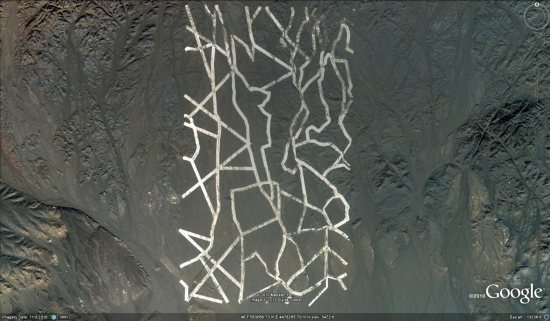
As reported by a handful of readers, a popular story about “strange lines in China” is making its way around the internet. There are a variety of odd-looking items in the area of the Kumtag desert, but this one is the most striking:


lines.jpg 

You can view that location in Google Earth by using this KML file.

The big question is: what is it? Some theories I’ve seen floating around online:

• Calibrating grid for a Chinese spy satellite.

• Lines drawn with white material.

• Dust dug by machinery.

• Street map of Washington, DC.

There’s certainly other possibilities as well. What do you think it is?

(via Gizmodo)

Improved sharing via Google+

A few weeks ago Larry mentioned that we’d start shipping the Google part of Google+. The Android team then launched Ice Cream Sandwich, with a focus on improved sharing via Google+. And today we’re rolling out two more Google+ features that integrate with two more Google products: YouTube and Chrome.

YouTube

It’s no secret that YouTube is filled with tons of great content (from inspiring speeches to music videos to honey badgers). We wanted to bring YouTube directly into Google+—as well as make it easier to watch and share your favorites—so we’re launching a YouTube “slider” in the stream. Here’s how it works:

  • Mouse over the new YouTube icon at the top right of Google+
  • It’ll slide out and ask, “What would you like to play”?
  • Enter whatever you’re in the mood for (like a topic or a musical artist)

Sharing YouTube videos with your circles also works (of course), but there’s a nice little twist: the people you share with can open a related playlist directly from your post! Last but not least, we’re starting to include YouTube playlists in Google+ search results.

YouTube video in the stream (left), YouTube playlist in Google+ search results (right)

Chrome

We’re also rolling out two new Google+ Chrome extensions:

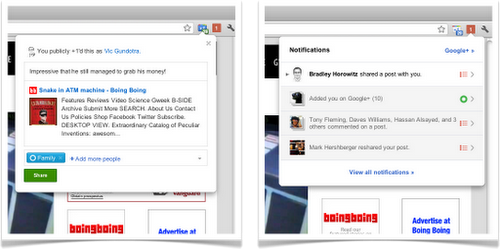
  • +1 button: +1 any webpage and share it with your circles
  • Notifications: check your Google+ notifications while you browse the web

Of course, if you don’t use Chrome, then you can use Google Toolbar for Internet Explorer. The new version—also rolling out today—includes these same sharing and notification features.

Google+ Chrome extensions: +1 button (left), notifications (right)

We’ve got lots more planned for Google+, YouTube and Chrome (and all the other Google products you already use). But we hope you enjoy today’s small taste of shipping the Google in Google+.

Hack4Transparancy for everyone

A few weeks ago we told you about the Hack4Transparancy event, bringing techies together November 8th and 9th in the European Parliament for an all-expenses-paid good time eating, talking, and making important data accessible to everyone.
Well, now we’ve got more exciting news. We’ve broadened the scope of the event and extended the application deadline for those wishing to make data on Internet performance visible and meaningful.
What’s changed?
The application deadline for the Internet Quality track has been extended through noon, CET, Friday October 21st (that’s this coming Friday).
To diversify the skill-set of interested hackers, we’ve added a data visualization option to the Internet Quality track.
We’ve expanded the criteria — now, eligible hackers from anywhere in the world can apply.
And, we’ve increased the prize money. One winning team or individual on each track will now receive €5.000,00.

The Pictarine: Building a mashup in the cloud with Google App Engine


Pictarine is a photo management web application, launched in 2010, that allows people to easily manage and share all of their photos from Flickr, Picasa, Facebook, Twitter and other sites. Pictarine developers Guillaume Martin and Maxime Rafalimanana have contributed the following post discussing their experiences using Google App Engine and Google Web Toolkit.

From the start, we used Google technologies in developing Pictarine and we wanted to share our experience with them so far. In this post, we will shed some light on the weaknesses and strengths we found in Google Web Toolkit (GWT) and Google App Engine. We will also discuss how we leveraged GWT to build a new technology that allows Pictarine to seamlessly display photos from the computer directly into the browser. The following diagram is an overview of how our application works.

Building a mashup in the cloud with Google App Engine

The Pictarine team is made of a web designer and two developers who previously worked mainly with Java based enterprise technologies and had a little experience with web technologies. When we started the project in early 2009, we were quite open on learning new languages like Python or Ruby, but when App Engine announced that Java would be supported, we were really excited to give Google App Engine a try.

The first few months, learning about the App Engine environment was quite easy and dare I say fun. Testing our code on Google’s servers from Eclipse IDE was only one click away. So we built our first prototype fast and we quickly decided to adopt App Engine. Then we started to build the core of our application: the engine that uses the API from Flickr, Picasa, Facebook to fetch the users’ photos. This is where we hit the first limitations of App Engine. Most users have a lot of photos on these services and retrieving them can take some time. But App Engine has strict limits on how long a request should last: an outgoing HTTP request cannot last more than 10 seconds and cannot process a request for more than 30 seconds. So while building our architecture we found ourselves writing approximately one third of our code dealing with these limitations: paginating our requests, creating background tasks to store data in small batches, etc.

In early 2010, when we launched our alpha version, everything went smoothly. We had some good press coverage and App Engine met our expectations in handling our first users. During 2010, we worked on implementing new features requested by our users, and during this period of time we were really impressed by the way App Engine evolved. Many of the limitations were lifted and great new features were added. We are now able to use Task Queues for requests that last up to 10 minutes, which we fully use to sync our users’ photos and albums. One of the features we like the most is the Channel API, a push notification system that allows us to instantly show a photo in every connected browser as soon as it is uploaded.
App Engine is still not perfect but has greatly improved and when we see its roadmap, we are quite confident it will continue to improve.