Victor’s Vectors: GTN 635, 625 and 725 now available!


GTN750 RFstack1

The GTN 750 and GTN 650 were announced and available for shipping March 23 when Garmin unveiled them at the Aircraft Electronics Association (AEA) Convention. Also announced at that time were the GTN 635, GTN 625, and GTN 725. As of July 1st these GTN models are now available for purchase and shipping. So what is the difference between the different GTN models? Basically, the GTN 625 and GTN 725 are GPS only, while the GTN 635 is a GPS/COM. The GTN 650 and GTN 750 are GPS/NAV/COM. For a more detailed list of the differences I’ve included a comparison chart from the GTN mini-site. The GTN 625 is priced at $9,595, the GTN 635 at $10,495, and the GTN 725 at $15,000. Now the full line of GTN models are available in a price range for your budget, so to start your panel upgrade visit a Garmin Aviation Dealer near you.


Now even faster and easier Google Search app for iOS

Two months ago, Google launched a redesign of the Google Search app for iOS. They were happy that many of you liked the new look and interactivity of the app. However, we also heard your feedback about the app’s speed. Today we’re introducing changes that make the app more responsive as well as other visual changes that make search results even easier to read.

Faster app performance


This version of Google Search app is up to 20% more responsive as you type search queries and interact with it. As part of the speed improvements, a feature called “Just Talk” will now be off by default. Just Talk allowed you to search via voice just by bringing the phone to your ear and speaking rather than tapping the microphone icon. Turning off this feature may improve app performance, though you can easily re-enable it under the Settings > Voice Search menu.

Turn Just Talk on or off

Improved look & feel for search results

When searching on a phone, the small screen sometimes makes it difficult to read small fonts or to tap precisely on a link. To help you read and tap with ease, we’ve made the font of our search results bigger and the entire search result is now a tap target rather than just the link.

See the difference between previous (left) and new interface (right) with results now easier to read and select

Thank you for your feedback. Please continue to let us know how we can improve your experience by going to Settings > Help and Feedback > Feedback.

Google Search app is available for devices running iOS 3.0 and above. Download it from the App Store or by scanning the QR code below:

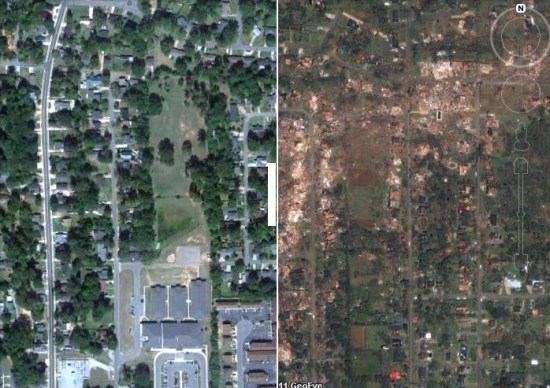
Before/after shots of the Tuscaloosa storm

In the days following the Japanese earthquake and tsunami, we showed you a great tool from ABC news that used Google Earth imagery with a slider to flip back and forth between pre and post-earthquake imagery.

Now we’ve been shown a similar tool for showing damage from the tornadoes that hit Tuscaloosa, and it’s just as impressive and heart-breaking as the Japanese imagery.

tuscaloosa-slider.jpg

To try it for yourself, simply head over to this page on the Tuscaloosa News site. Use the blue buttons on the right side to select an area to view, and slide the white bar from side-to-side to view the difference in the imagery.

Record Melt in Greenland in 2010

Record Melting in Greenland during 2010 NASA Earth Observatory has a map showing the record melt of Greenland’s ice cap in 2010, during which the melt started earlier and lasted longer than usual. “This image was assembled from microwave data from the Special Sensor Microwave/Imager (SSM/I) of the Defense Meteorological Satellites Program. Snow and ice emit microwaves, but the signal is different for wet, melting snow than for dry. Marco Tedesco, a professor at the City College of New York, uses this difference to chart the number of days that snow is melting every year. This image above shows 2010 compared to the average number of melt days per year between 1979 and 2009.”

Global Warming Map – Review pt II


continued from Part I last week

Layer Control: The plugin version has no layer control available to control the individual impact layers (you can turn them on and off as a group) so you can’t get around the multiple areas problem I outline above. You can control impact layers in the GEarth file but it’s confusing:
there are 6 levels of folders and way too many elements in this folder view. It could be a lot simpler which would improve usability.
Non-Spatial Data and Closing Balloons: In the above screenshot you can see a folder titled ‘background information’ is provided. It’s non-spatial data so it shouldn’t be in GEarth at all – better to link to a set of web pages elsewhere showing the same information and avoid cluttering up the GEarth layers panel.
While I’m talking about ‘Background info’ its sub-folders (even though they don’t have a folder icon, that’s what they are) have pop up balloons with a black background so you can’t see where to click the cross to close the balloon.
Poor Balloon Design: There are a number of issues with the pop up balloons;
Information Density: IMHO balloons are there to hold extra information (including images or videos) that cannot be presented easily as a traditional map symbol/key system. If you read the actual text in the forest fire example below the information you are actually getting is: ‘high forest fire danger projected to affect every populated continent’. Unnecessarily it then tells you where the areas are that are affected – this is a map, that’s what the polygons are communicating, no need to say it again in text. So there’s little new information in the balloon, it’s interesting to compare with the amount of data you get in placemark balloons in the Dafur project
Large Fonts: The top design is from the Impacts section in the GEarth plugin, the font is way too large decreasing the total amount of text that can be put in the balloon. Its less of an issue in the GEarth file with the text more reasonably proportioned, I suspected someone re-used the KML in the main file in the plugin without customising it to this different presentation. Kirsty confirms that this was so and says that she asked for the large font size to ‘give more prominence to the headline messages we were communicating with this map’. My answer is that with smaller fonts you can add extra detail towards the bottom of a balloon without forcing the user to click a link, users will close a balloon happily when they’ve read enough information. Again, the Dafur project is a good example.
Lack of Design Coherence: The two balloons from two different sections also don’t marry visually, as can be seen above. This isn’t good graphical design, you should have a consistent look across a project (e.g. across all pages of bbc.co.uk). Kirsty explains that this is because the data comes from two different organisations (the Foreign Office and the Met Office) who do very different things (act on science, research science respectively). Kirsty says this difference needs to be ‘absolutely clear[in the mind of the user]‘. I can understand that need but if the difference is so important, why isn’t it explained anywhere and why do the different data sets share a map in the first place?

Placemarks in Placemarks: In Google Earth opening ‘FCO Climate Change’ folder and then clicking the Spanish placemark you get an Inception-esque Google map within a GEarth map as captured in the screenshot below. Bizarrely you can open placemarks within a placemark leading to visual confusion.
Temperature Map Key: The temperature map overlay just about works in the original map as there is a key showing what the colors mean. However, in the GEarth file the key has become too small to read (its not available in the plugin). Most users will guess the heat colours corresponding to hot and cool temperatures but a readable key adds value.
Temperature Map Contours: The temperature map has heat contours on it out in the sea. These aren’t labelled and I would predict that most users won’t know what they are so it ends up just cluttering up the view.
Down-under Problem: I mentioned the fact you can’t compare Australia and the UK at the same time in a virtual globe in the skim review.
Talking Heads: The project links to video clips of experts talking about their specialisms within the topic area, they’re presented as talking head with no visual aids. Compare the style with a trailer from Wonders of the Solar system (one of the most successful science series the BBC has had)

Unless you are an exceptionally talented speaker (I’m certainly not) it’s very difficult to maintain a user’s attention as a talking head. Notice in the second clip that you never see Brian Cox against a static studio screen, the BBC are always trying to help the viewer visualise the point he’s making by putting him on location or providing a visualisation.

You don’t need a large travel and/or CGI budget to achieve this sort visual interest as I hope I showed in my latest climate change talk using GEarth as my main visualisation tool.
Kirsty comments that “they just wanted scientists to appear as the ordinary people they are”, that’s an understandable aim but I don’t think it relates to the ‘visual aids’ point I’ve made.

Conclusion:

This is not a failure as a project, I think its main positive is that the ‘what happens with 4 deg warming’ approach is a great choice to communicate climate science to the public. However, if the design had been thought through more it could have been a lot better.
I wasn’t a huge fan of the original map version of this project (e.g it had the same area problem) but it was OK. The vast majority of the issues I raise here have been introduced by moving the content to GEarth without thinking through what the pros and cons are of GEarth client/plugin as a presentation tool.
In relation to the above paragraph, Kirsty asks “This is the key point. The question is really, can GEarth be used to successfully display this map? … …the challenge we had was to present an existing map, already well-known, in the GEarth format”. My answer is that no, GEarth is not the best choice of medium if the data (as in this case) relates to inter-continental scales because of the downunder problem. I may elaborate in the future on what IMHO GEarth is best at.