Unified Map Design of Bing Maps and Nokia

Last year, we entered into a strategic partnership with Nokia which included plans to offer a unique and compelling mapping experience for our customers. Since then we’ve been working with Nokia and Windows Phone to deliver a unified map style based on one set of design principles with the goal of providing a more intuitive and pleasing online mapping experience. Our Bing Maps designers teamed closely with our partners at Nokia Maps and the Windows Phone team to unify our map elements, improve contrast and usability to ultimately create a more beautiful and functional map. Today we’re excited to share the new map design, available on desktop and mobile versions of Bing and Nokia maps.

Let’s take a closer look at the updates.

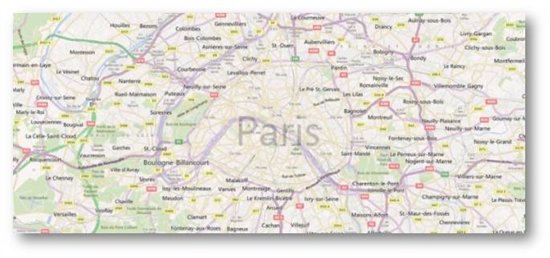
Common color palette for road map style
We’ve updated our color palette to create a cleaner and consistent view of roads and landmarks resulting in a map that’s easier to interpret. For instance, the new road color is further clarified from rivers while not competing with traffic colors or overlaid information.
Celebrate Typography

We focused significantly on improving various typography components in order to provide further clarity on maps including font updates, improved readability and contextual labeling. Type size hierarchy further delineates classes of labels. The user watches city names consistently grow and become more transparent through the zoom levels. Small type is demystified from its surroundings with a technique that reduces clutter instead of adding glows or ever-present strokes. The right use of typography helps our customers consume mapping details more quickly.

Using Visual Hierarchy to create Focus and maintain context

At each level, there’s an appropriate amount of information conveyed to the user. Too little or too much information can lead to overload and thereby an unpleasant user experience. We’ve redesigned with this in mind, so a very different level of information is presented to you when you zoom compared to when you pan out. Go in for detail, pull back for context. We strive to keep the orientation and context of a user within the map surface persistent across various levels of zoom.

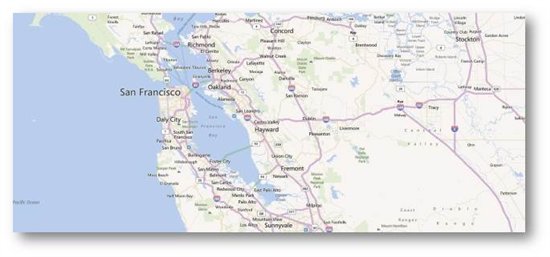
In addition to our map design updates, we’re also adding a significant amount of mapping coverage and data due to our partnership with Nokia and NavTeq. Each map data refresh from NavTeq brings with it many improvements, and each one also attempts to include as many new roads/subdivisions/ changes/etc. as possible.  This update is no exception and the changes are too vast to list but most notably, there are a few entire countries that really improved including Egypt, Israel, Malta, Philippines, Uruguay and Venezuela to name a few.

All in all, we believe that the new map styles available on Bing Maps (http://www.bing.com/maps) and Nokia Maps (http://maps.nokia.com) and on your mobile device are easy, satisfying, and truly a delight to use.
The New Android Market for Phones


[This post is by Eric Chu, Android Developer Ecosystem. —Dirk Dougherty]

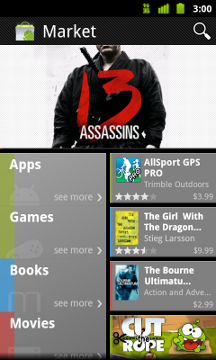
Earlier this year, we launched several important features aimed at making it easier to find great applications on Android Market on the Web. Today, we’re very excited to launch a completely redesigned Android Market client that brings these and other features to phones.

The new Market client is designed to better showcase top apps and games, engage users with an improved UI, and provide a quicker path to downloading or purchasing your products. For developers, the new Android Market client means more opportunities for your products to be merchandised and purchased.

In the home screen, we’ve created a new promotional page that highlights top content. This page is tiled with colorful graphics that provide instant access to featured apps and games. The page also lets users find their favorite books and movies, which will help drive even more return visits to Market.

To make it fun and easy for users to explore fresh content, we’ve added our app lists right to the Apps and Games home pages. Users can now quickly flip through these lists by swiping right or left, checking out what other people are downloading in the Top Paid, Top Free, Top Grossing, Top New Paid, Top New Free, and Trending lists. To keep the lists fresh and relevant, we’ve made them country-specific for many of the top countries.

To help you convert visitors to customers, we’ve made significant changes to the app details page. We’ve moved the app name and price into a compact action bar at the top of the page, so that users can quickly download or purchase your app. Directly below, users can flip through screen shots by swiping right or left, or scroll down to read your app’s description, what’s new, reviews, and more. To help you promote your product more effectively, the page now also includes a thumbnail link to your product video which is displayed at full screen when in landscape orientation.

For users who are ready to buy, we’ve streamlined the click-to-purchase flow so that users can complete a purchase in two clicks from the app details page. During the purchase, users can also see a list of your other apps, to help you cross-sell your other products.

With a great new UI, easy access to app discovery lists, a convenient purchase flow, and more types of content, we believe that the new Market client will become a favorite for users and developers alike.

Watch for the new Market client coming to your phone soon. We’ve already begun a phased roll-out to phones running Android 2.2 or higher — the update should reach all users worldwide in the coming weeks. We encourage you to try the update as soon as you receive it. Meanwhile, check out the video below for an early look.

Google Maps 5.7 for Android introduces Transit Navigation (Beta)

Google releasing Google Maps 5.7 for Android. From Bangkok to Baltimore, they added Transit Navigation (Beta), updated access to directions, better suggested search results, and a photo viewer to Place pages—all of which can help you whether you’re traveling to an unfamiliar part of town or visiting a city across the world.

Transit Navigation (Beta)
Google Maps Navigation (Beta) currently provides over 12 billion miles of GPS-guided driving and walking directions per year. Now, GPS turn-by-turn (or in this case, stop-by-stop) navigation is available for public transit directions in 400+ cities around the globe with Transit Navigation.
Transit Navigation uses GPS to determine your current location along your route and alerts you when it’s time to get off or make a transfer. This is particularly helpful if you’re in a city where you don’t speak the language and can’t read the route maps or understand the announcements. After starting your trip with Transit Navigation, you can open another application or put your phone away entirely and Google Maps will still display an alert in your notification bar and vibrate your phone when your stop is coming up.

Left: Transit directions without Navigation. Right: with Navigation

Navigation alerts appear even if you switch to another app
Now you can spend more time enjoying the sights out the window and less time worrying about how many stops are left, where you are along the route or whether you missed your stop. Since Transit Navigation relies on GPS signals, we recommend using this feature for above-ground transit.

Updated Directions
Now that we’ve improved our directions services, we wanted them to be incredibly easy to pull up on your screen. If you select the driving or walking icon and your route is supported by Google Maps Navigation, the Navigation icon will automatically appear so you can get access to step-by-step directions in one click. Note: this change is currently only in place for driving and walking and does not appear for public transit.

One-click access to Navigation from directions
We’ve also streamlined how you access directions from within a Place page. Before, clicking directions in a Place page would bring up options for “Driving Navigation,” “Walking Navigation” and “Directions.” Now, you’ll be taken straight to the map and see the new directions box shown above.

Improved Search Suggest
We’ve made two changes to search suggestions that improve their quality and speed. First, we’ve added category icons, so instead of all search suggestions displaying the same icon, the icon next to the listing will reflect the type of result. You’ll see a pin for a Google Places listing, a star for a starred Place or location, a clock for a previously used search term, a person for contacts and a magnifying glass for “anything else.”

Two examples of search suggest with new icons
Also, any place you got directions to or called directly from its Places page will be included as a suggestion for a relevant search. For example, if you recently received directions to the U.S. Post Office on Wilshire Boulevard, afterward, when you begin a search with [p] or [bou], that U.S. Post Office would appear as a search suggestion.

Photo viewer for Place pages
Since we released business photos for Place pages last October, millions of photos have been added to Place pages around the world. To enable you to view these photos on the run, a slick new photo viewer has been added so you can browse photos while deciding where to go.

Left: Business photos in Place pages. Right: New photo viewer
To start using Google Maps 5.7 for Android, download the update here. This update requires an Android OS 2.1+ device and works anywhere Google Maps is currently available.

Animate your SketchUp models

In the past five years since Google purchased SketchUp (and then made it free), we’ve seen it receive a ton of improvements. Last fall saw the release of SketchUp 8, which added a bunch of great new features, and last month they released another update that provided SpaceNavigator support and a very helpful bug fix.

Despite all of that, there is still one feature missing that users are wanting — animation. Wouldn’t it be great to be able to animate your models from within SketchUp? Thanks to developer MorisDov and his “Proper Animation” plugin, now you can!

Check out the video below for a brief sample:

The plugin works by allowing you to create various positions for your model, and then those model moves to those various positions, creating the animation. It’s a very useful plugin, and I’m sure many SketchUp modelers will be thankful to MorisDov for creating it.

To get started, head over to his site, read this SketchUcation thread, or head over to the Google SketchUp Blog for a nice walk-through.

Have you tried this plug-in yet? What do you think of it?