How to get the most out of your aviation portable this Spring


Springtime is in full swing as the fragrance of blossoming flowers fills the air, newborn bunnies gather in the backyard to nibble on clover, and pilots flock to the Garmin website for… software updates?

Split Screen 3D Vision and Weather2Spring is a great time to dedicate some of your spring-cleaning time toward your GPS!

SketchUp for Game Design

I’ve yet to meet a SketchUp modeler who doesn’t—at least just a little bit—want to work in the video game design industry. I get a stupid grin on my face when I think about how much fun it it would be to make battle tanks and exploding oil drums and secret doors for hidden basements full of zombies. In the gaming world, boring things like gravity and cost take a backseat to novelty and sheer coolness.

But how to turn your SketchUp habit (and job cranking out toilet stall details) into days full of armor design and wandering through bad neighborhoods looking for interesting photo-textures to shoot?


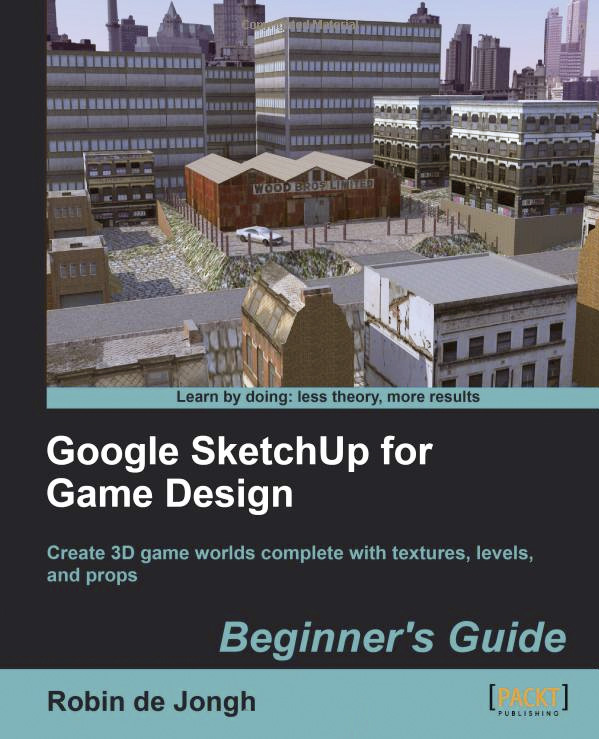
Google SketchUp for Game Design is Robin de Jongh’s newest book; he also wrote SketchUp 7.1 for Architectural Visualization. It presumes that you’re a SketchUp beginner, but then quickly gets on to the good stuff:

  • Finding good resources for photo-textures
  • Using Meshlab to convert your models in useable 3D game assets
  • Working with the Unity 3D game engine (which is widespread, free-or-low-cost middleware for designing game levels)
  • Creating high-quality textures for games
  • Adapting your models for use in video games
  • Authoring custom levels
  • Modeling low-poly game assets (including cars) and selling them online

Robin’s writing is accessible and easy to follow. He packs a lot of information into each page, but manages to keep the tone friendly and even funny at times. While the book’s in black and white, color versions of the images are available from the publisher’s website.

The New Android Market for Phones


[This post is by Eric Chu, Android Developer Ecosystem. —Dirk Dougherty]
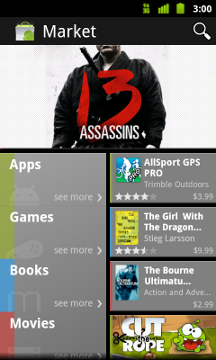
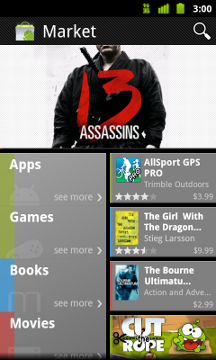
Earlier this year, we launched several important features aimed at making it easier to find great applications on Android Market on the Web. Today, we’re very excited to launch a completely redesigned Android Market client that brings these and other features to phones.

The new Market client is designed to better showcase top apps and games, engage users with an improved UI, and provide a quicker path to downloading or purchasing your products. For developers, the new Android Market client means more opportunities for your products to be merchandised and purchased.

In the home screen, we’ve created a new promotional page that highlights top content. This page is tiled with colorful graphics that provide instant access to featured apps and games. The page also lets users find their favorite books and movies, which will help drive even more return visits to Market.

To make it fun and easy for users to explore fresh content, we’ve added our app lists right to the Apps and Games home pages. Users can now quickly flip through these lists by swiping right or left, checking out what other people are downloading in the Top Paid, Top Free, Top Grossing, Top New Paid, Top New Free, and Trending lists. To keep the lists fresh and relevant, we’ve made them country-specific for many of the top countries.

To help you convert visitors to customers, we’ve made significant changes to the app details page. We’ve moved the app name and price into a compact action bar at the top of the page, so that users can quickly download or purchase your app. Directly below, users can flip through screen shots by swiping right or left, or scroll down to read your app’s description, what’s new, reviews, and more. To help you promote your product more effectively, the page now also includes a thumbnail link to your product video which is displayed at full screen when in landscape orientation.

For users who are ready to buy, we’ve streamlined the click-to-purchase flow so that users can complete a purchase in two clicks from the app details page. During the purchase, users can also see a list of your other apps, to help you cross-sell your other products.

With a great new UI, easy access to app discovery lists, a convenient purchase flow, and more types of content, we believe that the new Market client will become a favorite for users and developers alike.

Watch for the new Market client coming to your phone soon. We’ve already begun a phased roll-out to phones running Android 2.2 or higher — the update should reach all users worldwide in the coming weeks. We encourage you to try the update as soon as you receive it. Meanwhile, check out the video below for an early look.
OpenStreetMap (Ramm, Topf and Chilton)

OpenStreetMap: Using and Enhancing the Free Map of the World
by Frederik Ramm, Jochen Topf and Steve Chilton
UIT Cambridge, 2010. Paperback, 352 pp.
ISBN 978-1-906860-11-0

Book cover: OpenStreetMap Last year saw the publication in English of two books about OpenStreetMap. This one, Frederik Ramm and Jochen Topf’s OpenStreetMap, saw three German editions before being translated into this English edition, which Steve Chilton assisted with.

This is a comprehensive manual on using OpenStreetMap and its data, covering everything from contributing user data to editing, to using and hacking OSM data on websites and in applications. In other words, it covers everything — though not necessarily in thorough detail, with lots of references to OSM wiki pages for more information.

Now I’ve always found the OSM wiki to be a bit overwhelming; I think that this book does a better job of getting people up to speed on using OSM than trying to navigate the wiki pages (which is how I got up to speed, and wished for something clearer). Those who spend a lot of time on OSM will do well to have this on their shelf.

I think OSM needs more contributors, at least in Canada, where edits I left unfinished months ago are unchanged when I get back to them. So I read this book with an eye as to whether it would help beginners contribute. The first two parts of the book do a very good job of introducing the mapping process — collecting tracks, editing map data — to beginners, or at least that’s my impression. I even learned a couple of new things, and I’m a little less trepidatious about using JOSM (all my edits to date have been with Potlatch).


But people who are only interested in uploading GPS tracks and editing the map, rather than using OSM data in mashups and applications, won’t need to read past page 160.

Things move fast in the tech world, and the book has already been overtaken in one regard: most of the examples use Potlatch 1, which has been replaced by Potlatch 2 as the default web editor; I had to work to remember how to use the old editor. Serves me right for taking so long to get to this review.