Sharing Rich Content From Your Android Apps, to Google+ and Beyond

Many developers have been using Android’s share intent to help their users share content with others, directly from their apps. With the recently-launched ShareCompat library, you can now help your users share rich content with their friends (like images and videos) more easily, and the items they share include attribution to your app. All you need to do is add a few lines of code!

I’ll walk through a few examples that use Google+ as the application handler, but of course, these share intent improvements can work for any service. Popular apps like Foodspotting, Pulse News, and Shazam are already using ShareCompat to help users share rich content with their Google+ circles. You can check out this photo album to see how they are all taking advantage of the new library.

Creating the Share Intent

If you’d like users to be able to share text from your app, start by building the following intent:

Intent shareIntent = ShareCompat.IntentBuilder.from(ShareActivity.this)
   .setText("This site has lots of great information about Android!
      http://www.android.com")
   .setType("text/plain")
   .getIntent()
   .setPackage("com.google.android.apps.plus");

startActivity(shareIntent);

Here, I passed text and a URL to the setText method, and I used the setType method to identify the content as “text/plain.” The intent builder can then pass this information to the application that’s doing the sharing. Additionally, I used the setPackage method to specify the application that I want to handle it. In this case, the Google+ application is specified.
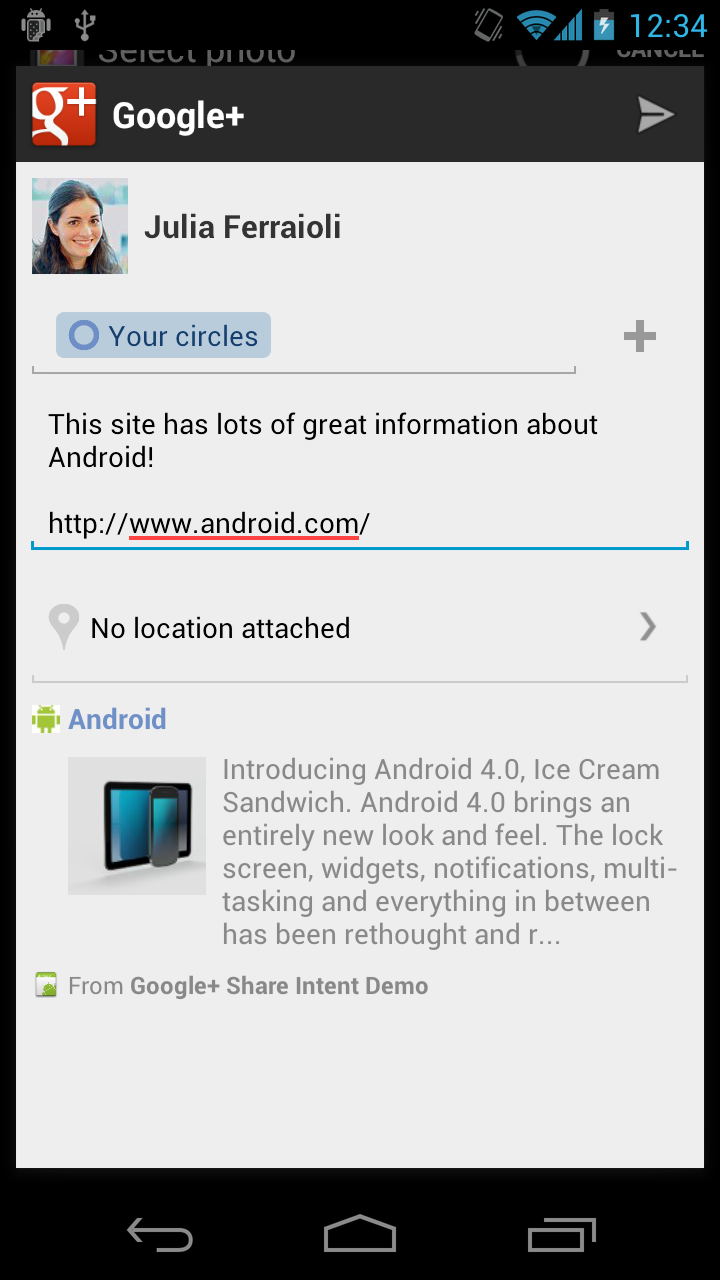
The Google+ share box with pre-populated text and link snippet.


Introducing the SketchUp Showcase


It’s our sincere pleasure to unveil The SketchUp Showcase, a home for the most impressive, interesting, and inspiring project stories that have been shared with us.

Why a new showcase? Often, when you find an amazing model in the 3D Warehouse, it doesn’t tell the full story behind a project. You can download it and see how it was built. But you probably wouldn’t get a sense of why it was built. Where did the inspiration come from? What were the design challenges the modeler faced? What happened after the model was finished? The story just isn’t complete.

The Showcase is a space where the stories, images, renders, animations, and 3D models of passionate SketchUppers can shine a bit brighter.


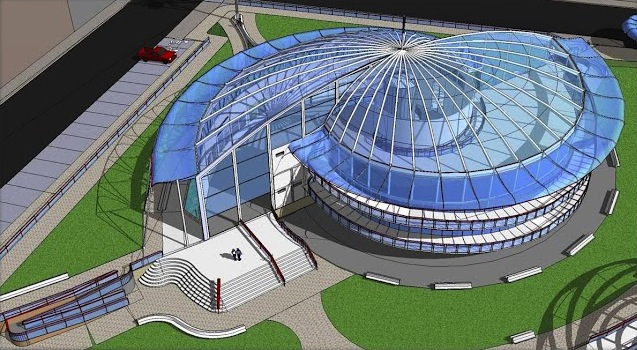
What was the inspiration behind this 3D model? | Image courtesy of Roberto Bergamo 


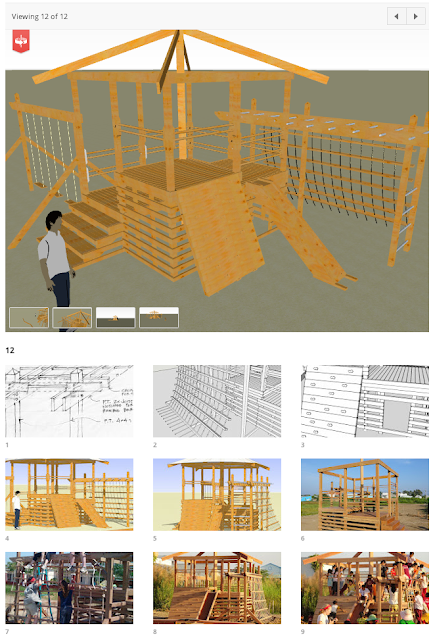
But that’s not all – the Showcase is also a first look at a new element of SketchUp technology: an online 3D model viewer. This 3D viewer lets you orbit, zoom, and pan 3D models right in your browser! To see it in action, find a project marked with a red flag or simply click here. Please note: you’ll need to use the latest version of Google Chrome to take advantage of the WebGL goodness that makes this viewer possible.

Go ahead and start exploring now; content is organized by category filters, so you can easily find projects based on your interests.

A project page featuring the new online 3D viewer | The Catalyst Playground in VietnamFinally, our team would like to dedicate the SketchUp Showcase to all the passionate SketchUppers who’ve supported us for over a decade. As we enter a new chapter with Trimble, we hope the Showcase and the online viewer are proof that SketchUp is only getting better. It’s clichéd to say we wouldn’t be much of anywhere without you, but that doesn’t make it any less true. Thank you for all of the love (sometimes tough) you’ve sent our way. Your passion for SketchUp is still what gets us out of bed in the morning.

Now playing: Faster movie search on Android and iPhone

With the December movie season in full swing, we’ve just made it even faster and easier to discover movies, showtimes and theaters, all from your smartphone. Now when you search for [movies] or your favorite theater like [century san francisco] on Google.com from your phone, you’ll see interactive results for movies in a new swipeable ribbon, with the most relevant information displayed at the top of the page.

For each movie, you’ll see the movie poster, a short summary, ratings and the nearest theaters and showtimes. Designed to help you quickly browse what’s playing in theaters now, this information instantly updates as you slide through the movie posters — no need to wait for a page to load or to use the back button.

To learn more about a movie, tap the movie title to find details like the cast and a full summary. And if you see a play button on the movie poster, you can tap to view the official trailer. You can even buy tickets directly from your smartphone by tapping on underlined showtimes — and skip past those long holiday box office lines!

So the next time you head out to see sagas of vampires, the world’s biggest Muppets fan, dancing penguins or nearly impossible heists, try the new interactive results for movies by visiting Google.com on your iOS or Android phone’s browser and searching for [movies], [theaters] or a movie title. This feature is available in English, in the US.

(Cross-posted on the Inside Search blog)

Now you can test your Mobile Web Apps with WebDriver

Mobile testing has come a long way since the days when testing mobile web applications was mostly manual and took days to complete. Selenium WebDriver is a browser automation tool that provides an elegant way of testing web applications. WebDriver makes it easy to write automated tests that ensure your site works correctly when viewed from an Android or iOS browser.

For those of you new to WebDriver, here are a few basics about how it helps you test your web application. WebDriver tests are end-to-end tests that exercise a web application just like a real user would. There is a comprehensive user guide on the Selenium site that covers the core APIs.

Now let’s talk about mobile! WebDriver provides a touch API that allows the test to interact with the web page through finger taps, flicks, finger scrolls, and long presses. It can rotate the display and provides a friendly API to interact with HTML5 features such as local storage, session storage and application cache. Mobile WebDrivers use the remote WebDriver server, following a client/server architecture. The client piece consists of the test code, while the server piece is the application that is installed on the device.

Get Started


WebDriver for Android and iPhone can be installed following these instructions. Once you’ve done that, you will be ready to write tests. Let’s start with a basic example using www.google.com to give you a taste of what’s possible.

The test below opens www.google.com on Android and issues a query for “weather in san francisco”. The test will verify that Google returns search results and that the first result returned is giving the weather in San Francisco.

public void testGoogleCanGiveWeatherResults() {
// Create a WebDriver instance with the activity in which we want the test to run.
WebDriver driver = new AndroidDriver(getActivity());
// Let’s open a web page
driver.get(“http://www.google.com”);

// Lookup for the search box by its name
WebElement searchBox = driver.findElement(By.name(“q”));

// Enter a search query and submit
searchBox.sendKeys(“weather in san francisco”);
searchBox.submit();

// Making sure that Google shows 11 results
WebElement resultSection = driver.findElement(By.id(“ires”));
List searchResults = resultSection.findElements(By.tagName(“li”));
assertEquals(11, searchResults.size());

// Let’s ensure that the first result shown is the weather widget
WebElement weatherWidget = searchResults.get(0);
assertTrue(weatherWidget.getText().contains(“Weather for San Francisco, CA”));
}

Now let’s see our test in action! When you launch your test through your favorite IDE or using the command line, WebDriver will bring up a WebView in the foreground allowing you to see your web application as the test code is executing. You will see www.google.com loading, and the search query being typed in the search box.


We mentioned above that the WebDriver supports creating advanced gestures to interact with the device. Let’s use WebDriver to throw an image across the screen by flicking horizontally, and ensure that the next image in the gallery is displayed.

WebElement toFlick = driver.findElement(By.id(“image”));
// 400 pixels left at normal speed
Action flick = getBuilder(driver).flick(toFlick, 0, -400, FlickAction.SPEED_NORMAL)
.build();
flick.perform();
WebElement secondImage = driver.findElement(“secondImage”);
assertTrue(secondImage.isDisplayed());

Next, let’s rotate the screen and ensure that the image displayed on screen is resized.


assertEquals(landscapeSize, secondImage.getSize())
((Rotatable) driver).rotate(ScreenOrientation.PORTRAIT);
assertEquals(portraitSize, secondImage.getSize());

Let’s take a look at the local storage on the device, and ensure that the web application has set some key/value pairs.


// Get a handle on the local storage object
LocalStorage local = ((WebStorage) driver).getLocalStorage();
// Ensure that the key “name” is mapped
assertEquals(“testUser”, local.getItem(“name”));

What if your test reveals a bug? You can easily take a screenshot for help in future debugging:


File tempFile = ((TakesScreenshot) driver).getScreenshotAs(OutputType.FILE);

High Level Architecture

WebDriver has two main components: the server and the tests themselves. The server is an application that runs on the phone, tablet, emulator, or simulator and listens for incoming requests. It runs the tests against a WebView (the rendering component of mobile Android and iOS) configured like the browsers. Your tests run on the client side, and can be written in any languages supported by WebDriver, including Java and Python. The WebDriver tests communicate with the server by sending RESTful JSON requests over HTTP. The tests and server pieces don’t have to be on the same physical machine, although they can be. For Android you can also run the tests using the Android test framework instead of the remote WebDriver server.

Infrastructure Setup

At Google, we have wired WebDriver tests to our cloud infrastructure allowing those tests to run at scale and making it possible to have them run in our continuous integration system. External developers can run their mobile tests either on emulators/simulators or real devices for Android and iOS phones and tablets.
Android emulators can run on most OSes because they are virtualized, so we run them on our generic cloud setup. Though there are many advantages to using Android emulators because they emulate a complete virtual device (including the virtual CPU, MMU, and hardware devices), it makes the test environment slower. You can speed up the tests by disabling animations, audio, skins, or even by running in the emulator headless mode. To do so, start the emulator with the options –no-boot-anim, –no-audio, –noskin, and –no-window. If you would like your tests to run even faster, start the emulator from a previously created snapshot image. That reduces the emulator startup time from 2 minutes to less than 2 seconds!
iOS simulators can’t be virtualized and hence need to run on Mac machines. However, because iOS simulators don’t try to emulate the virtual device or CPU at all, they can run as applications at “full speed,” this allows the test to run much faster.
Stay tuned for more mobile feature in Selenium WebDriver, and updates on the Selenium blog.

Ice Cream Sandwich on the Galaxy Nexus

Beaming a video with a single tap or unlocking a device with only a smile sounds like science fiction. Now, you can actually do these things (and more) with a phone that fits in the palm of your hand.

Wednesday morning in Hong Kong—together with Samsung—we unveiled Galaxy Nexus, the first phone designed for the latest release of Android 4.0, also known as Ice Cream Sandwich.

With a super slim profile, Galaxy Nexus features a 4.65” Contour Display with true high definition (720p) resolution and a lightning-fast dual core 1.2ghz processor combined with 4G LTE or HSPA+ technology. Galaxy Nexus also features the latest in software: Ice Cream Sandwich makes Android simple and beautiful, and takes the smartphone to beyond smart.

Beauty and simplicity
With Ice Cream Sandwich, our mission was to build a mobile OS that works on both phones and tablets, and to make the power of Android enticing and intuitive. We created a new font that’s optimized for HD displays and eliminated all hardware buttons in favor of adaptable software buttons. We also dramatically improved the keyboard, made notifications more interactive and created resizable widgets.

The desktop-class browser is significantly faster, featuring a refined tab manager and the ability to sync your bookmarks with Google Chrome. Ice Cream Sandwich also features the best mobile Gmail experience to date, with a new design that lets you quickly swipe through your inbox and search messages even when you’re offline. Calendar boasts a clean new look and you can zoom into your schedule with a pinch.

Connect and share
People are at the heart of Ice Cream Sandwich. We rethought how you browse your contacts with the new People app, which combines high-resolution photos and updates from Google+ and other social services. It’s also easier to capture and share your life with family and friends. Galaxy Nexus sports a high-end camera with zero shutter lag, automatic focus, top notch low-light performance and a simple way to capture panoramic pictures. Shoot amazing photos or 1080p video, and then edit and share them directly from your phone.

Beyond smart
Galaxy Nexus isn’t just a smartphone—it’s beyond smart. Ice Cream Sandwich gives you complete control over the amount of mobile data you use by helping you better understand and manage it. We’re also introducing Android Beam, which uses near field communication (NFC) to instantly share webpages, YouTube videos, maps, directions and apps by simply tapping two phones together. Face Unlock uses state-of-the-art facial recognition technology to unlock your phone with nothing more than a smile.

This weekend marks the third birthday of the G1, the first-ever Android phone. Nine releases later, more than 550,000 Android devices are activated daily.

Starting in November, Galaxy Nexus will be available in the United States, Canada, Europe and Asia. Check out the Nexus website for a product tour and more info.